2026 · Day 1🤝 Community & Social Responsibility✍️ Full model answers
Playing at the Playground
Stimulus-based conversation practice · 3 questions · about 10 minutes
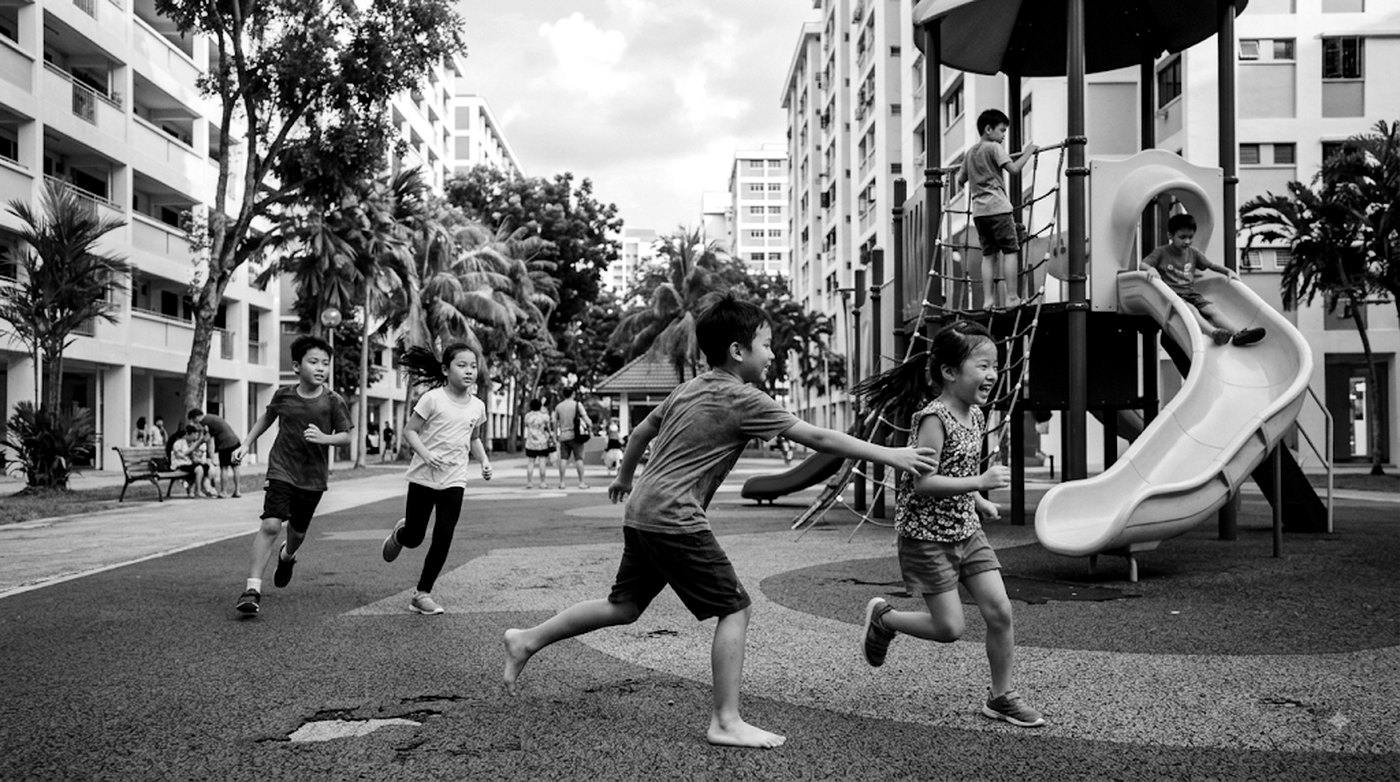
About this drill: Candidates reported that the Day 1 stimulus was printed in black and white, which caught many by surprise. Ours is shown the same way. Themes are compiled from what candidates and parents recalled after the examination. SEAB does not release the papers, so treat them as recollections, not a record. Every picture, question and model answer on this site is our own. psleoral.sg is not affiliated with SEAB or MOE.
Let your child look at the picture for 30 seconds before the first question.
30
Look at the picture together
The questions
Ask these in order. Wait five full seconds after each one before helping — the silence is where the thinking happens.
Q1Describe the stimulus
Look at the picture. What are the children doing, and how can you tell they are enjoying themselves?
Look, name, and explain what you see — then add one detail nobody else would notice.
0:00
Listen back. Did you…
Nothing is uploaded or saved — the recording stays on this device.
Model answer
In the picture, a group of children are playing a game of catching on the rubberised ground of a playground in a housing estate. One boy is stretching his arm out to tag a girl who is running away from him, and two other children are running in from the left. Behind them, one child is climbing the rope netting while another comes down the slide. I can tell they are enjoying themselves because they are laughing rather than arguing, and nobody is standing at the side on their own. What I also noticed is that the boy in front is running barefoot, so he has been playing long enough to kick his shoes off somewhere.
Why it scores
Names the game rather than saying “playing”, gives evidence for the feeling instead of asserting it, and closes on a detail — the bare feet — that implies how long they have been there.
Show the answer frame instead
Point to what you see"In the picture, I can see…" — name two or three specific things, not just one.
Say how you can tell"I can tell they are… because…" — give evidence, do not just state the feeling.
Add one closer detail"What I also noticed is…" — this is what lifts a plain answer into a strong one.
Q2Relate it to yourself
Tell me about a game you like to play outdoors with your friends. What do you enjoy about it?
Give a real example from your own life. Say what happened, then how you felt.
0:00
Listen back. Did you…
Nothing is uploaded or saved — the recording stays on this device.
Model answer
My friends and I play catching at the void deck under my block almost every evening after homework. What I like about it is that you do not need anything to start — no ball, no court, just whoever turns up. There was one evening when a boy I had never met asked if he could join, and within ten minutes he was part of the game and we knew his name. I do not think that would have happened if we had all been sitting with our phones. That is the part I enjoy most, more than the running.
Why it scores
Answers the actual question — what they enjoy — and the reason is unexpected and specific, about how easily a stranger joined in rather than the obvious “it is fun”.
Show the answer frame instead
Name the game and where"My friends and I play… at…" — be specific about the place.
Say what you enjoy about it"What I like about it is…" — this is the part most answers skip.
Give one example"There was one evening when…" — one story beats a list of reasons.
Q3Give your opinion
Some people say children today spend too little time playing outdoors. What do you think, and what could be done?
Take a clear stand, give a reason, acknowledge the other side, then close.
0:00
Listen back. Did you…
Nothing is uploaded or saved — the recording stays on this device.
Model answer
I agree that we play outdoors less than we should. Outdoor play teaches things a screen cannot — you have to ask to join in, take turns, and sort out an argument yourself when someone says they were not really tagged. It is also better for our eyes and we sleep better afterwards. I understand why many parents are cautious, because the afternoon sun is punishing and a child alone downstairs is a real worry, however that is an argument for going down at five or six rather than not going at all. That is why I believe the answer is not more rules about screens but a fixed time each day when going downstairs is simply what happens.
Why it scores
The reason is concrete — sorting out a disputed tag — rather than “exercise is good”, and it answers both halves of the question by ending on something a family could actually do.
Show the answer frame instead
Take a clear stand"I agree that… / I feel that…" — never start with "maybe".
Give your strongest reason"This is because…" — one solid reason beats three weak ones.
Show you see the other side"I understand why some people feel that…, however…" — this shows maturity.
Close with what could be done"That is why I believe…" — answer the second half of the question.
Useful phrases for this topic
Frames your child can use while answering. Tap any phrase to copy it.
A game of catching…
On the rubberised ground…
Taking turns on the slide…
Without anyone being left out…
You do not need anything to start…
Better than being on a screen…
What I also noticed is…
This reminds me of the time when…
I understand why some people feel that way, however…
That is why I believe…
Common mistakes on this kind of question
Saying only "they are playing"Name the game. “A game of catching” tells the examiner far more than “playing”.
Stating the feeling with no evidence"They are happy" is a claim. "They are laughing rather than arguing" is proof.
Missing the backgroundMost answers describe only the children in front. The slide and the rope netting are part of the picture too.
Answering in one line"Yes, I would." A full answer needs a reason and an example — aim for three or four sentences.
No reason givenEvery opinion needs a "because". Without it, the answer sounds like a guess.
Parent script — how to run this in 10 minutes
Show the picture. Say nothing for 30 seconds.
Ask Q1 exactly as written. Count to five in your head before you help.
After the answer, ask "why?" once more. That single word usually doubles the answer.
Repeat for the remaining questions.
Finish with one thing that was good and one thing to try next time. Only one of each.