2024 · Day 2🤝 Community & Social Responsibility✍️ Full model answers
Thanking the School Attendants
Stimulus-based conversation practice · 3 questions · about 10 minutes
About this drill: Candidates that year described a poster for School Attendants Appreciation Week. Our picture is a reconstruction of the scene, not the examination stimulus. Themes are compiled from what candidates and parents recalled after the examination. SEAB does not release the papers, so treat them as recollections, not a record. Every picture, question and model answer on this site is our own. psleoral.sg is not affiliated with SEAB or MOE.
Let your child look at the picture for 30 seconds before the first question.
30
Look at the picture together
The questions
Ask these in order. Wait five full seconds after each one before helping — the silence is where the thinking happens.
Q1Describe the stimulus
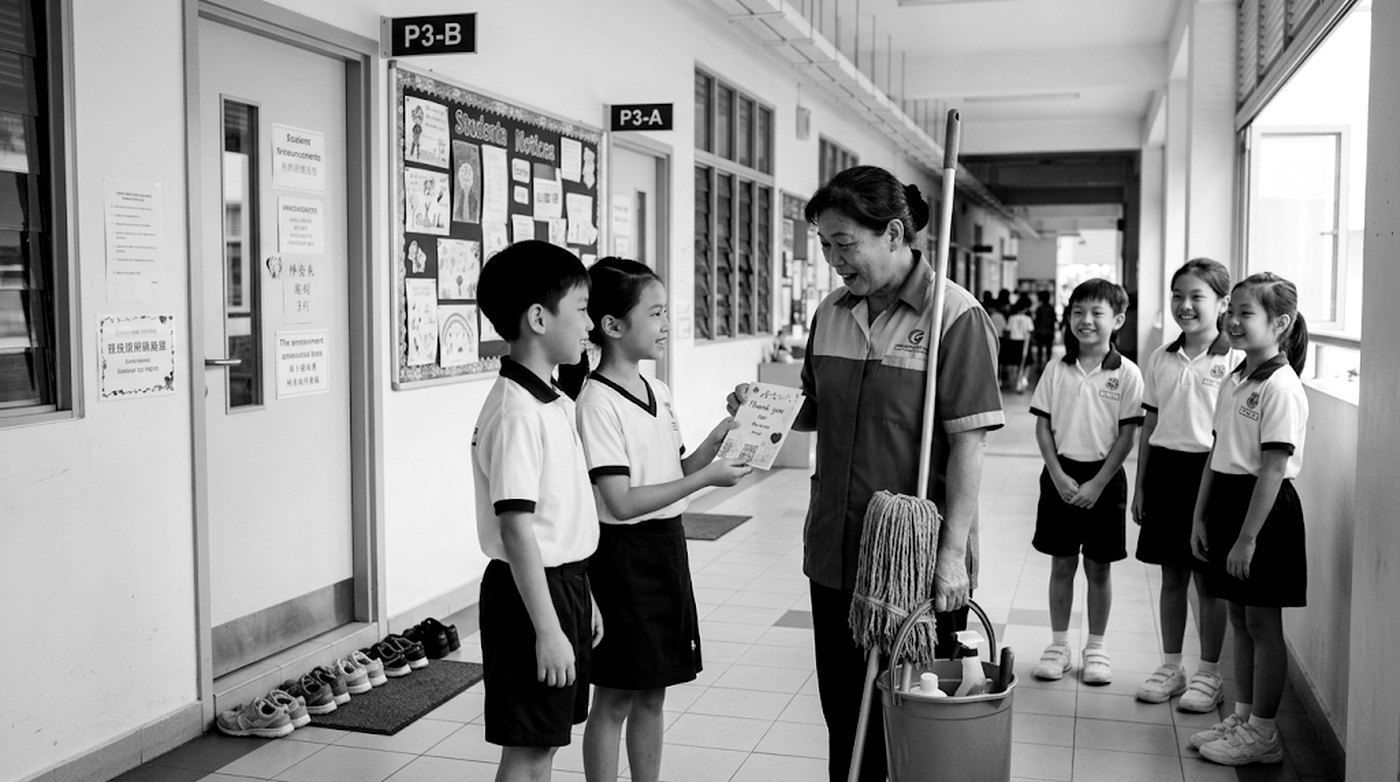
Look at the picture. What are the pupils doing, and how does the cleaner seem to feel?
Look, name, and explain what you see — then add one detail nobody else would notice.
0:00
Listen back. Did you…
Nothing is uploaded or saved — the recording stays on this device.
Model answer
In the picture, two pupils are standing in a school corridor handing a handmade card to a cleaner, who is holding a mop with her bucket beside her. Three or four other pupils are standing a little further back, watching and smiling. The cleaner looks surprised and pleased — she has stopped mid-task and is leaning forward to look at the card properly rather than just taking it. What I also noticed is that the card is clearly handmade rather than bought, which probably means more to her than something from a shop would.
Why it scores
Reads the feeling from a specific action — stopping work to look properly — and the closing point about handmade versus bought adds an idea rather than a description.
Show the answer frame instead
Point to what you see"In the picture, two pupils are…" — name the action, not just the people.
Say how she seems to feel"She looks…because…" — give evidence, do not just state the feeling.
Add one closer detail"What I also noticed is…" — this is what lifts a plain answer into a strong one.
Q2Relate it to yourself
Tell me about someone in your school you think deserves more appreciation. Why?
Give a real example from your own life. Say what happened, then how you felt.
0:00
Listen back. Did you…
Nothing is uploaded or saved — the recording stays on this device.
Model answer
I would say the two cleaners who look after our block. There was a week when a boy in my class was unwell and was sick in the corridor outside our room, and one of them came and cleared it without making any comment about it at all, which I think saved him a lot of embarrassment. Most of us walk past them every morning without saying anything. After that week I started saying good morning to them, and now one of them knows my name. It costs nothing and I am not sure why I did not do it earlier.
Why it scores
Chooses a real incident rather than a general virtue, and the honest admission at the end is far stronger than claiming to have always been grateful.
Show the answer frame instead
Name the person"I would say…" — pick one person, not a category.
Give the reason with a story"There was a week when…" — one incident does the work.
Say what changed"After that, I…" — examiners are listening for this part.
Q3Give your opinion
Some people say we only appreciate the people who do these jobs during an appreciation week. What do you think?
Take a clear stand, give a reason, acknowledge the other side, then close.
0:00
Listen back. Did you…
Nothing is uploaded or saved — the recording stays on this device.
Model answer
I think that is largely true, and it is worth admitting rather than arguing about. For the rest of the year most of us walk past the cleaners without looking up, and then for one week there are cards and posters everywhere. I understand the criticism that this makes the whole thing feel arranged rather than sincere. However, I would rather have the week than not have it, because it is often the thing that makes someone notice for the first time — I only learnt our cleaner's name because of one. That is why I believe the point of the week is not the week itself but whether anything is different in the month after it.
Why it scores
Concedes the criticism honestly instead of defending the ritual, then rescues it with a personal fact and a genuinely sharp closing test.
Show the answer frame instead
Take a clear stand"I think that is largely true…" — agreeing can be the braver answer.
Give your reason"For the rest of the year…" — be specific about what actually happens.
Show you see the other side"However, I would rather…" — then say why.
Close it"That is why I believe…" — a proper ending, not a trailing off.
Useful phrases for this topic
Frames your child can use while answering. Tap any phrase to copy it.
A handmade thank-you card…
School attendants and cleaners…
Stopped what she was doing…
Surprised and pleased…
We walk past them every day…
It costs nothing to say…
What I also noticed is…
This reminds me of the time when…
I understand why some people feel that way, however…
That is why I believe…
Common mistakes on this kind of question
Describing only the pupilsThe cleaner's reaction is the point of the picture.
Stating the feeling with no evidence"She is happy" is a claim. "She stopped working to look at the card" is proof.
Picking a teacher for the second questionTeachers already get thanked. The question is asking who gets overlooked.
Answering in one line"Yes, I would." A full answer needs a reason and an example — aim for three or four sentences.
No reason givenEvery opinion needs a "because". Without it, the answer sounds like a guess.
Parent script — how to run this in 10 minutes
Show the picture. Say nothing for 30 seconds.
Ask Q1 exactly as written. Count to five in your head before you help.
After the answer, ask "why?" once more. That single word usually doubles the answer.
Repeat for the remaining questions.
Finish with one thing that was good and one thing to try next time. Only one of each.