2024 · Day 1🤝 Community & Social Responsibility✍️ Full model answers
The Opening of a New Park
Stimulus-based conversation practice · 3 questions · about 10 minutes
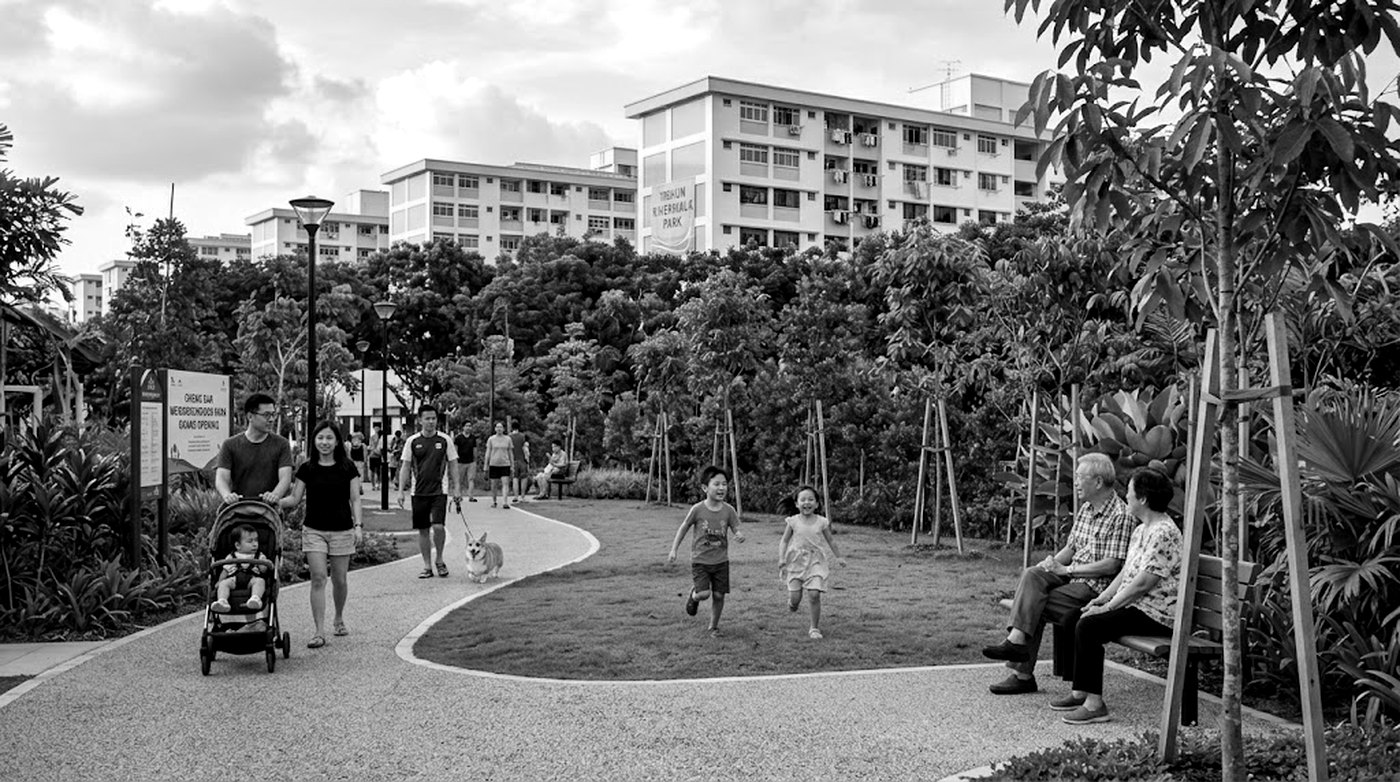
About this drill: Candidates that year described a poster announcing the opening of a new neighbourhood park. Our picture is a reconstruction of the scene, not the examination stimulus. Themes are compiled from what candidates and parents recalled after the examination. SEAB does not release the papers, so treat them as recollections, not a record. Every picture, question and model answer on this site is our own. psleoral.sg is not affiliated with SEAB or MOE.
Let your child look at the picture for 30 seconds before the first question.
30
Look at the picture together
The questions
Ask these in order. Wait five full seconds after each one before helping — the silence is where the thinking happens.
Q1Describe the stimulus
Look at the picture. What is happening at this park, and who is using it?
Look, name, and explain what you see — then add one detail nobody else would notice.
0:00
Listen back. Did you…
Nothing is uploaded or saved — the recording stays on this device.
Model answer
In the picture, a new park in a housing estate has just opened and people have come down to use it. Two children are running across the open lawn, a family is walking along the path with a baby in a stroller, and a man is walking his dog behind them. On the right, an elderly couple are sitting on a bench in the shade. What I also noticed is that the young trees still have wooden stakes tied to them to hold them upright, so this park was only planted recently and has not had time to grow in yet.
Why it scores
Names several different groups rather than saying “many people”, and the closing detail about the stakes proves the park is new without needing to read a sign.
Show the answer frame instead
Point to what you see"In the picture, I can see…" — name two or three specific things, not just one.
Say who is using it"Two children are…, while an elderly couple…" — different people, different activities.
Add one closer detail"What I also noticed is…" — this is what lifts a plain answer into a strong one.
Q2Relate it to yourself
Tell me about a park or open space near your home. What do you do there?
Give a real example from your own life. Say what happened, then how you felt.
0:00
Listen back. Did you…
Nothing is uploaded or saved — the recording stays on this device.
Model answer
There is a small park two blocks from my flat with a jogging path around the edge. My father and I go down most evenings after dinner, and while he walks the loop I usually cycle. What I like is that it is busy without being crowded — you always see the same few faces, the aunty who walks her two dogs, the uncles playing chess at the pavilion. One evening my chain came off and one of those uncles put it back on for me without being asked. I would never have met him if we only stayed upstairs.
Why it scores
A specific place with specific regulars, and the story earns the point about community instead of stating it.
Show the answer frame instead
Name the place"There is a park…near my home." — say where, roughly.
Say what you do there"My father and I…" — a real routine, not a general answer.
Give one moment"One evening…" — a small story beats a list.
Q3Give your opinion
Do you think it is important to have parks in a country as small as Singapore? Why?
Take a clear stand, give a reason, acknowledge the other side, then close.
0:00
Listen back. Did you…
Nothing is uploaded or saved — the recording stays on this device.
Model answer
I think it is important, and being small is the reason rather than the objection. Most of us live in flats without gardens, so a park is the only open space a family actually has. It is also where people meet neighbours they would otherwise never speak to, because you cannot bump into anyone in a lift lobby. I understand why some people argue that land here is scarce and that the same plot could hold flats or a school, which is a fair point when housing is expensive. However, I believe a city where there is nowhere to go outside becomes a place people only sleep in, and that is not the same as somewhere you want to live.
Why it scores
Turns the obvious objection — small country, scarce land — into the argument for parks, and the closing line makes a real distinction rather than repeating the question.
Show the answer frame instead
Take a clear stand"I think it is important…" — never start with "maybe".
Give your strongest reason"This is because…" — one solid reason beats three weak ones.
Show you see the other side"I understand why some people argue…, however…" — this shows maturity.
Close it"That is why I believe…" — a proper ending, not a trailing off.
Useful phrases for this topic
Frames your child can use while answering. Tap any phrase to copy it.
The park has just opened…
Along the landscaped path…
An open lawn where children can run…
Sitting in the shade of a tree…
The saplings are still staked…
A place to meet your neighbours…
What I also noticed is…
This reminds me of the time when…
I understand why some people feel that way, however…
That is why I believe…
Common mistakes on this kind of question
Saying only "there are people in the park"Say who they are and what each of them is doing.
Missing that the park is newThe staked saplings and fresh turf are the clue. Noticing it shows you looked properly.
A vague personal answer"I go to the park sometimes" says nothing. Name the place and what you actually do there.
Answering in one line"Yes, I would." A full answer needs a reason and an example — aim for three or four sentences.
No reason givenEvery opinion needs a "because". Without it, the answer sounds like a guess.
Parent script — how to run this in 10 minutes
Show the picture. Say nothing for 30 seconds.
Ask Q1 exactly as written. Count to five in your head before you help.
After the answer, ask "why?" once more. That single word usually doubles the answer.
Repeat for the remaining questions.
Finish with one thing that was good and one thing to try next time. Only one of each.