All topics › Past year questions

2023 · Day 2 🏠 Family & Home ✍️ Full model answers

Writing in Her Diary

Stimulus-based conversation practice · 3 questions · about 10 minutes

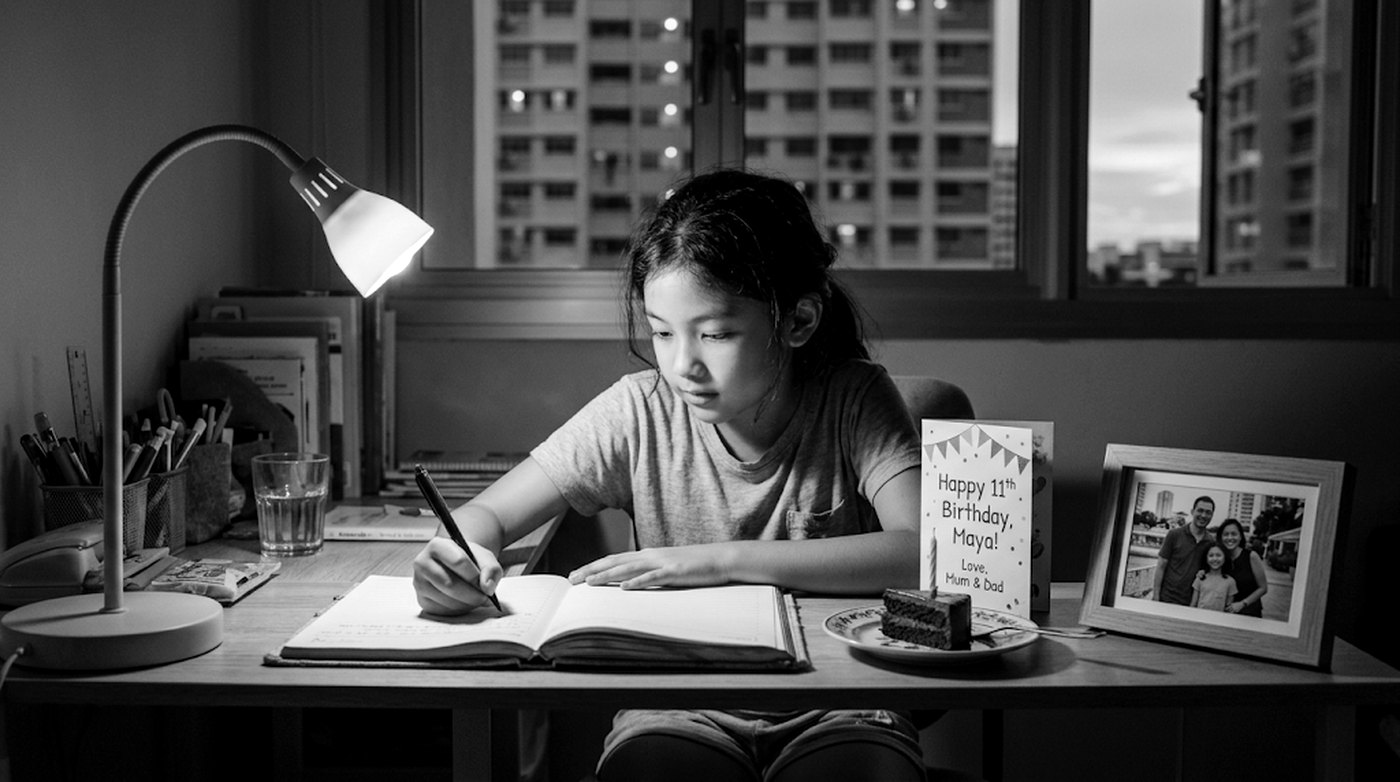
About this drill: Candidates that year described a girl writing in her diary, with a birthday card, cake and family photograph on the desk. Our picture is a reconstruction of the scene, not the examination stimulus. Themes are compiled from what candidates and parents recalled after the examination. SEAB does not release the papers, so treat them as recollections, not a record. Every picture, question and model answer on this site is our own. psleoral.sg is not affiliated with SEAB or MOE.
Writing in Her Diary — PSLE oral stimulus picture
Let your child look at the picture for 30 seconds before the first question.

The questions

Ask these in order. Wait five full seconds after each one before helping — the silence is where the thinking happens.

Q1Describe the stimulus

Look at the picture. What is the girl doing, and what can you tell about her day?

Look, name, and explain what you see — then add one detail nobody else would notice.

0:00
Model answer

In the picture, a girl is sitting at her desk in the evening writing in an open diary, with a desk lamp lit and the window behind her showing blocks of flats at dusk. On the desk beside her there is a birthday card standing open, a slice of cake on a plate with a bite taken out of it, and a framed photograph of her family. I can tell it is her birthday from the card, and that the celebration is already over because she is alone and writing about it rather than still at the table. What I also noticed is that she is writing rather than taking a photograph of the cake, which is a slower way of keeping the day.

Why it scores

Infers the time of day and that the party has ended, rather than only listing objects — and the final contrast between writing and photographing is a real idea.

Show the answer frame instead
  1. Point to what you see"In the picture, a girl is…" — name the action first.
  2. Say what you can work out"I can tell it is…because…" — evidence, not a guess.
  3. Add one closer detail"What I also noticed is…" — this is what lifts a plain answer into a strong one.
Q2Relate it to yourself

Do you keep anything to remember special days — photographs, a diary, or something else?

Give a real example from your own life. Say what happened, then how you felt.

0:00
Model answer

I keep a shoebox under my bed with things that would look like rubbish to anyone else. There is a wristband from an overseas trip, a ticket stub, and a note a friend passed me in Primary Three. Once a year or so I tip it out and go through it, and things I had completely forgotten come straight back — I could not have told you that friend's exact words, but seeing the note brought back the whole afternoon. I tried keeping a diary for about two weeks and gave up, so the box is what I have instead.

Why it scores

A specific, slightly unglamorous habit with real objects in it, and admitting the abandoned diary makes the whole answer more believable.

Show the answer frame instead
  1. Say what you keep"I keep a…" — be concrete about what it actually is.
  2. Give one example from it"There is a…" — name a real object and what it brings back.
  3. Be honest about the rest"I tried…and gave up" — honesty is more convincing than a perfect answer.
Q3Give your opinion

Some people say we take so many photographs now that we no longer remember things properly. What do you think?

Take a clear stand, give a reason, acknowledge the other side, then close.

0:00
Model answer

I think there is something in it. When you know a photograph exists you stop trying to hold on to the moment yourself, and half the time nobody looks at the picture again anyway. There is also a difference between watching something and photographing it — at my cousin's wedding I spent so long trying to get a good shot of the dinner that I barely remember the speeches. I understand why people disagree, because photographs bring back things we would genuinely have lost, and my grandmother's old album is the only reason I know what she looked like at my age. However, I believe the useful question is whether you are taking the picture to keep the day or to avoid having to pay attention to it.

Why it scores

Uses a concrete personal failure as evidence, gives the other side a genuinely strong case, and closes on a distinction the student has actually thought through.

Show the answer frame instead
  1. Take a clear stand"I think there is something in it." — say where you stand.
  2. Give your reason"When you know a photograph exists…" — explain the effect.
  3. Show you see the other side"I understand why people disagree, because…" — make it a real case.
  4. Close it"That is why I believe…" — a proper ending, not a trailing off.

Useful phrases for this topic

Frames your child can use while answering. Tap any phrase to copy it.

  • Writing in her diary…
  • A card standing open on the desk…
  • By the light of a desk lamp…
  • Keeping a memory of the day…
  • Long after the day is over…
  • Something to look back on…
  • What I also noticed is…
  • This reminds me of the time when…
  • I understand why some people feel that way, however…
  • That is why I believe…

Common mistakes on this kind of question

Listing the objects and stoppingThe card, cake and photograph are clues. Say what they tell you about her day.
Missing that the celebration is overShe is alone, writing about it. That is the quiet point of the picture.
Claiming to keep a perfect diaryIf you do not keep one, say so and describe what you do keep instead.
Answering in one line"Yes, I would." A full answer needs a reason and an example — aim for three or four sentences.
No reason givenEvery opinion needs a "because". Without it, the answer sounds like a guess.

Parent script — how to run this in 10 minutes

  1. Show the picture. Say nothing for 30 seconds.
  2. Ask Q1 exactly as written. Count to five in your head before you help.
  3. After the answer, ask "why?" once more. That single word usually doubles the answer.
  4. Repeat for the remaining questions.
  5. Finish with one thing that was good and one thing to try next time. Only one of each.

Found this useful? Send it to another parent:

Share on WhatsApp