All topics Arts, Culture & Heritage

🎨 Arts, Culture & Heritage ⭐ Exam favourite ✍️ Full model answers

Clay Creations at the Workshop

Stimulus-based conversation practice · 3 questions · about 10 minutes

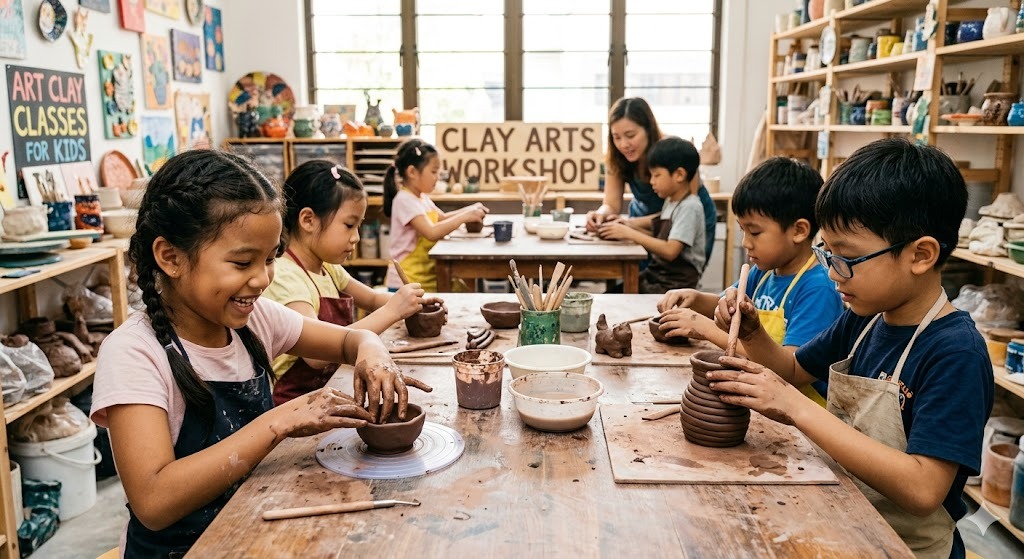
Clay Creations at the Workshop — PSLE oral stimulus picture
Let your child look at the picture for 30 seconds before the first question.

The questions

Ask these in order. Wait five full seconds after each one before helping — the silence is where the thinking happens.

Q1 Describe the stimulus

Look at the picture. What activity are the children doing, and what can you see on the table?

Look, name, and explain what you see — then add one detail nobody else would notice.

0:00
Model answer

In the picture, the children are taking part in a clay or pottery workshop. Each of them is shaping a lump of clay on the table, and I can see finished bowls and small figurines placed on a shelf at the side. On the table there are wooden shaping tools, a bowl of water for smoothing the clay, and aprons hanging on the chairs. What I also noticed is that the children's hands are quite messy, which suggests they have been working for a while and are not afraid to get dirty.

Why it scores

Answers both halves — activity and what is on the table — then reads how long they have been at it.

Show the answer frame instead
  1. Point to what you see"In the picture, I can see…" — name two or three specific things, not just one.
  2. Explain what is happening"It looks like… because…" — link what you see to why it is happening.
  3. Add one closer detail"What I also noticed is…" — this is what lifts a plain answer into a strong one.

Q2 Relate it to yourself

Tell me about something you have made with your hands. How did it turn out?

Give a real example from your own life. Say what happened, then how you felt.

0:00
Model answer

I once made a photo frame out of ice-cream sticks for my mother's birthday. It took me two afternoons, and the first version fell apart because I did not let the glue dry properly before adding the decorations. I had to start again, and the second one held together, although it was slightly crooked. My mother still has it on her dressing table, and I think she likes it more than the crooked corners deserve.

Why it scores

A failure, a second attempt, and a warm closing line with a touch of humour.

Show the answer frame instead
  1. Set the scene"This reminds me of the time when…" — say when and where in one line.
  2. Say what you did"What I did was…" — one clear action, not a list.
  3. Say how it felt or what you learnt"After that, I felt… because…" — examiners are listening for this part.
Q3 Give your opinion

Do you think schools should give students more time for art and craft activities? Why?

Take a clear stand, give a reason, acknowledge the other side, then close.

0:00
Model answer

Yes, I feel schools should. Art and craft give students a break from sitting still and writing, and some children who struggle with academic subjects discover that they are very good with their hands. It also teaches patience and problem-solving, because when something does not turn out right you have to work out why and try again. I understand that curriculum time is limited and examinations matter, however I believe a school that only trains us to sit for papers is not preparing us for everything life will ask of us.

Why it scores

Two solid reasons, then handles the time objection with a broad and confident closing statement.

Show the answer frame instead
  1. Take a clear stand"I feel that… / I agree that…" — never start with "maybe".
  2. Give your strongest reason"This is because…" — one solid reason beats three weak ones.
  3. Show you see the other side"I understand why some people feel that…, however…" — this shows maturity.
  4. Close it"That is why I believe…" — a proper ending, not a trailing off.

Useful phrases for this topic

Frames your child can use while answering these questions. Tap any phrase to copy it.

  • In the picture, I can see…
  • You can tell it is… because…
  • I have tried something similar when…
  • What I enjoy most about it is…
  • It is important to keep this because…
  • For young people today…
  • What I also noticed is…
  • This reminds me of the time when…
  • I understand why some people feel that way, however…
  • That is why I believe…

Common mistakes on this kind of question

Naming without describingSay how you can tell — the shape, the colour, the sound, the costume.
Saying it is "nice" or "interesting"Explain what specifically you enjoyed or noticed.
Forgetting why it mattersArts and heritage questions usually want a reason these things are worth keeping.
Answering in one line"Yes, I would." A full answer needs a reason and an example — aim for three or four sentences.
No reason givenEvery opinion needs a "because". Without it, the answer sounds like a guess.

Parent script — how to run this in 10 minutes

  1. Show the picture. Say nothing for 30 seconds.
  2. Ask Q1 exactly as written. Count to five in your head before you help.
  3. After the answer, ask "why?" once more. That single word usually doubles the answer.
  4. Repeat for the remaining questions.
  5. Finish with one thing that was good and one thing to try next time. Only one of each.

More topics like this

All 102 drills are free · No account · No payment

Want one picked for you each week?

Choosing between 102 drills at 8pm on a school night is its own problem. Leave your email and we will send one drill every Monday — nothing else, and you can stop any time.

One email a week. No spam, no sharing of your address.