All topics › Community & Social Responsibility

🤝 Community & Social Responsibility ✍️ Full model answers

Graciousness on the MRT

Stimulus-based conversation practice · 3 questions · about 10 minutes

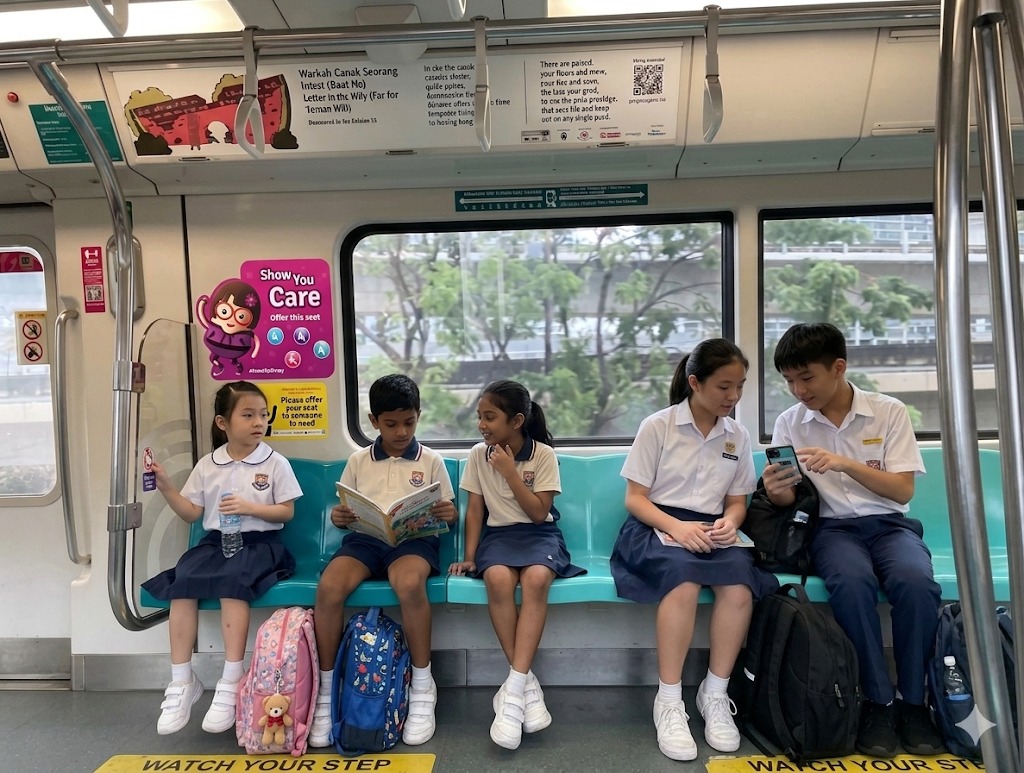
Graciousness on the MRT — PSLE oral stimulus picture
Let your child look at the picture for 30 seconds before the first question.

The questions

Ask these in order. Wait five full seconds after each one before helping — the silence is where the thinking happens.

Q1 Describe the stimulus

Look at the picture. What are the students in the MRT carriage doing?

Look, name, and explain what you see — then add one detail nobody else would notice.

0:00
Model answer

In the picture, the students are travelling in an MRT carriage during what looks like a busy period. Some are standing and holding the handrails, while others are seated with their school bags on their laps instead of on the empty seat beside them. I can see that the reserved seats near the door have been left free. What I also noticed is that one student is moving further into the carriage, which helps others get in.

Why it scores

Describes several behaviours, and picks out the small considerate actions rather than just saying 'they are sitting'.

Show the answer frame instead
  1. Point to what you see"In the picture, I can see…" — name two or three specific things, not just one.
  2. Explain what is happening"It looks like… because…" — link what you see to why it is happening.
  3. Add one closer detail"What I also noticed is…" — this is what lifts a plain answer into a strong one.

Q2 Relate it to yourself

Tell me about a time you gave up your seat or someone gave up a seat for you.

Give a real example from your own life. Say what happened, then how you felt.

0:00
Model answer

This reminds me of a morning when I was travelling to school and the train was very crowded. A pregnant lady came in at the next station and stood near the door, and I noticed her before the adults did. I stood up and offered her my seat, and although I had to stand for six stops with a heavy bag, she thanked me and looked much more comfortable. I remember feeling a little shy at that moment, but also quite proud of myself afterwards.

Why it scores

Honest about the small discomfort and the shyness, which makes it believable rather than a perfect story.

Show the answer frame instead
  1. Set the scene"This reminds me of the time when…" — say when and where in one line.
  2. Say what you did"What I did was…" — one clear action, not a list.
  3. Say how it felt or what you learnt"After that, I felt… because…" — examiners are listening for this part.
Q3 Give your opinion

In your opinion, how can we encourage more people to be gracious on public transport?

Take a clear stand, give a reason, acknowledge the other side, then close.

0:00
Model answer

I feel there are two useful ways. The first is through reminders that are easy to notice, such as the priority seat stickers and the announcements, because many people are simply not paying attention rather than being unkind. The second is by seeing others do it, since graciousness is quite contagious — when one person stands up, others often follow. Most importantly, I think schools should keep encouraging students, because habits formed young usually stay for life.

Why it scores

Two practical methods with reasons, plus a generous assumption about people, which sounds mature.

Show the answer frame instead
  1. Take a clear stand"I feel that… / I agree that…" — never start with "maybe".
  2. Give your strongest reason"This is because…" — one solid reason beats three weak ones.
  3. Show you see the other side"I understand why some people feel that…, however…" — this shows maturity.
  4. Close it"That is why I believe…" — a proper ending, not a trailing off.

Useful phrases for this topic

Frames your child can use while answering these questions. Tap any phrase to copy it.

  • In the picture, I can see…
  • This shows consideration because…
  • I remember a time when…
  • In my neighbourhood…
  • If more people did this…
  • It costs us very little to…
  • What I also noticed is…
  • This reminds me of the time when…
  • I understand why some people feel that way, however…
  • That is why I believe…

Common mistakes on this kind of question

Missing what is wrong in the pictureLook for the one detail that shows consideration — or the lack of it.
Judging harshlyAssuming people are lazy or rude sounds less mature than considering why they behaved that way.
General advice with no example"People should be more gracious" needs a real moment from your own life to support it.
Answering in one line"Yes, I would." A full answer needs a reason and an example — aim for three or four sentences.
No reason givenEvery opinion needs a "because". Without it, the answer sounds like a guess.

Parent script — how to run this in 10 minutes

  1. Show the picture. Say nothing for 30 seconds.
  2. Ask Q1 exactly as written. Count to five in your head before you help.
  3. After the answer, ask "why?" once more. That single word usually doubles the answer.
  4. Repeat for the remaining questions.
  5. Finish with one thing that was good and one thing to try next time. Only one of each.

Found this useful? Send it to another parent:

Share on WhatsApp

More topics like this

All 102 drills are free · No account · No payment

Two emails a year. That's all.

Every drill here is free, whenever you want it — you do not need us to send them. What is easy to miss is the timing. So we write twice a year: once just after the oral exam, when we post what actually came up, and once in May, when it is time to start practising for the next one.

Two emails a year. Nothing else, and you can unsubscribe any time.

Also from us

Results out in November. Which schools are in range?

Enter your child's four PSLE subject grades and see every secondary school within reach, using the latest 2026-intake cut-off points. Free, no account.

Open alscore.sg →