All topics PSLE Oral 2025

2025 · Day 1 🎨 Arts, Culture & Heritage ✍️ Full model answers

The Ice Cream Uncle's Queue

Stimulus-based conversation practice · 3 questions · about 10 minutes

About this drill: These are the two themes candidates reported after the 2025 oral examination. The pictures and questions here are our own — this is not a reproduction of the examination paper, and psleoral.sg is not affiliated with SEAB or MOE.
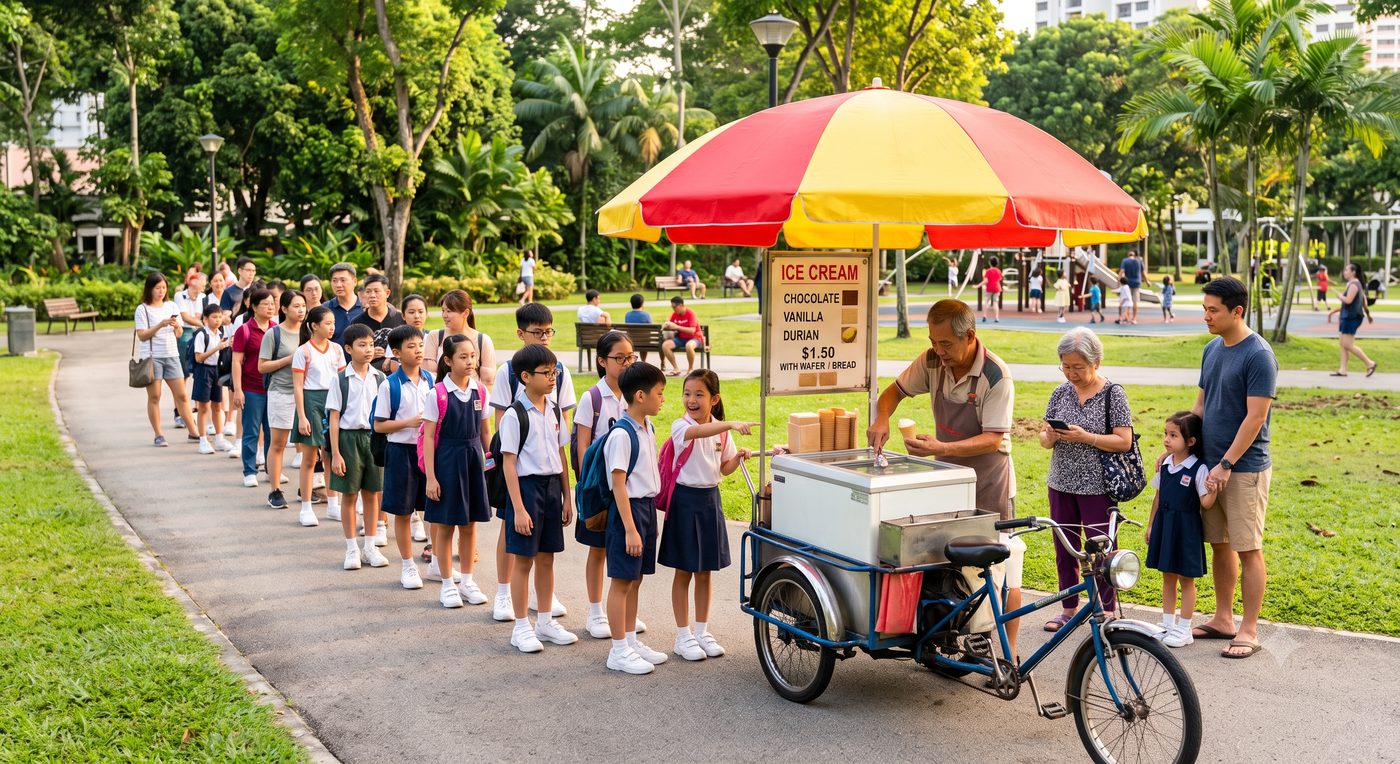
The Ice Cream Uncle's Queue — PSLE oral stimulus picture
Let your child look at the picture for 30 seconds before the first question.

The questions

Ask these in order. Wait five full seconds after each one before helping — the silence is where the thinking happens.

Q1 Describe the stimulus

Look at the picture. What is happening, and who is waiting in the queue?

Look, name, and explain what you see — then add one detail nobody else would notice.

0:00
Model answer

In the picture, an ice cream uncle is serving customers from his tricycle cart in a neighbourhood park, under a large red and yellow umbrella. A long queue has formed behind him, made up mostly of primary school pupils who are still in their uniforms with their bags on, along with a few parents and elderly residents. The handwritten board on the cart offers chocolate, vanilla and durian at $1.50, with a wafer or bread. What I also noticed is that the queue is orderly even though it is long — nobody is pushing to the front, and one girl is pointing at the flavours while she waits her turn.

Why it scores

Names the trade, reads the information on the sign, and closes by noticing how the queue is behaving rather than only how long it is.

Show the answer frame instead
  1. Point to what you see"In the picture, I can see…" — name two or three specific things, not just one.
  2. Say who is there"The queue is made up mostly of…" — describe the people, not only the numbers.
  3. Add one closer detail"What I also noticed is…" — this is what lifts a plain answer into a strong one.
Q2 Relate it to yourself

Tell me about a time you had to wait a long time for something. How did you feel?

Give a real example from your own life. Say what happened, then how you felt.

0:00
Model answer

Last year my mother brought me to a bakery that had just opened near our block, and the queue stretched past three other shops. We waited close to forty minutes, my legs were aching, and I kept asking whether we could simply come back another day. My mother told me the aunty inside was shaping every bun by hand, which was why it was so slow. When we finally got ours they were still warm, and I understood why nobody in that queue had complained. After that I stopped grumbling so quickly whenever I had to wait.

Why it scores

Admits impatience honestly, and the turning point comes from understanding the person on the other side of the counter — far more convincing than claiming to be patient.

Show the answer frame instead
  1. Set the scene"This reminds me of the time when…" — say when and where in one line.
  2. Say what happened"We waited about…" — one clear situation, not a list.
  3. Say how it felt or what you learnt"After that, I…" — examiners are listening for this part.
Q3 Give your opinion

Do you think traditional trades like the ice cream uncle should be preserved? Why?

Take a clear stand, give a reason, acknowledge the other side, then close.

0:00
Model answer

I feel they should be, although I know it is not simple. These carts are part of how Singaporeans of every generation grew up, and a block of ice cream folded into a slice of rainbow bread for $1.50 is not something you can buy anywhere else in the world. The difficulty is that almost all the uncles are elderly now and very few young people want to take over, because the hours are long and the earnings are small. I understand why some people feel that a trade cannot be forced to survive if nobody wants to do it, however I believe we can at least make it easier for those still working — giving them more places where they are allowed to park, and choosing them over a convenience store when we walk past. That is why I believe preserving this trade is really a question of whether we still stop and buy.

Why it scores

Takes a side, gives the strongest reason concretely rather than saying “it is our culture”, faces the real obstacle honestly, and closes on something the student themselves can do.

Show the answer frame instead
  1. Take a clear stand"I feel that… / I agree that…" — never start with "maybe".
  2. Give your strongest reason"This is because…" — one solid reason beats three weak ones.
  3. Show you see the other side"I understand why some people feel that…, however…" — this shows maturity.
  4. Close it"That is why I believe…" — a proper ending, not a trailing off.

Useful phrases for this topic

Frames your child can use while answering these questions. Tap any phrase to copy it.

  • In the picture, a long queue has formed…
  • Still in their school uniforms…
  • Waiting patiently for their turn…
  • A trade that is slowly disappearing…
  • Part of growing up in Singapore…
  • It costs very little, but…
  • What I also noticed is…
  • This reminds me of the time when…
  • I understand why some people feel that way, however…
  • That is why I believe…

Common mistakes on this kind of question

Saying only "there are many people"Say who they are and what they are doing. A queue of uniformed pupils tells the examiner far more than a crowd.
Ignoring the signThe flavours and the price are written in the picture. Using them proves you looked carefully.
Treating it as only about ice creamThe strongest answers notice that this is an older trade with very few people left to carry it on.
Answering in one line"Yes, I would." A full answer needs a reason and an example — aim for three or four sentences.
No reason givenEvery opinion needs a "because". Without it, the answer sounds like a guess.

Parent script — how to run this in 10 minutes

  1. Show the picture. Say nothing for 30 seconds.
  2. Ask Q1 exactly as written. Count to five in your head before you help.
  3. After the answer, ask "why?" once more. That single word usually doubles the answer.
  4. Repeat for the remaining questions.
  5. Finish with one thing that was good and one thing to try next time. Only one of each.

Keep going

All drills are free · No account · No payment

Want one picked for you each week?

Choosing between 102 drills at 8pm on a school night is its own problem. Leave your email and we will send one drill every Monday — nothing else, and you can stop any time.

One email a week. No spam, no sharing of your address.