All topics Past year questions

2026 · Day 2 🤝 Community & Social Responsibility ✍️ Full model answers

A Crowded Bus

Stimulus-based conversation practice · 3 questions · about 10 minutes

About this drill: Shown in black and white, as candidates reported the 2026 stimulus pictures were. Themes are compiled from what candidates and parents recalled after the examination. SEAB does not release the papers, so treat them as recollections, not a record. Every picture, question and model answer on this site is our own. psleoral.sg is not affiliated with SEAB or MOE.
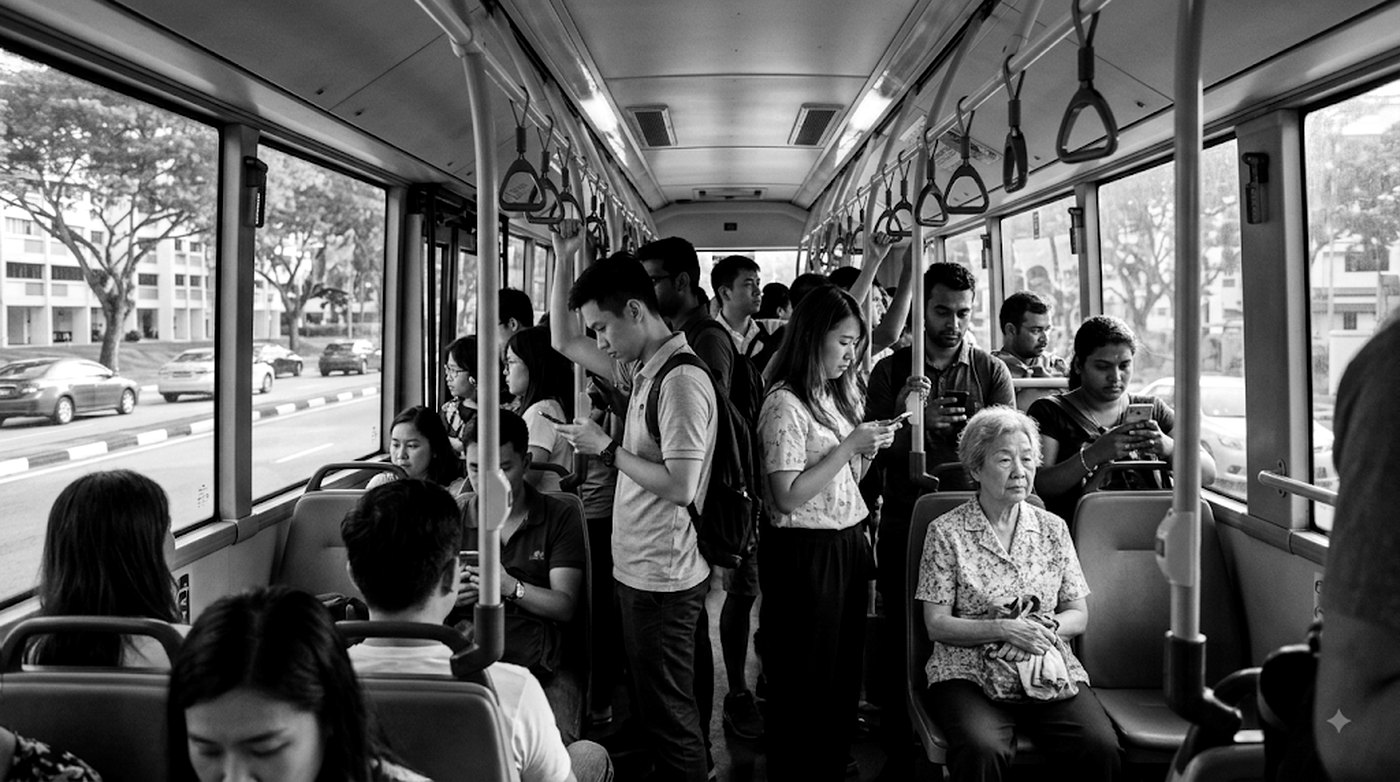
A Crowded Bus — PSLE oral stimulus picture
Let your child look at the picture for 30 seconds before the first question.

The questions

Ask these in order. Wait five full seconds after each one before helping — the silence is where the thinking happens.

Q1Describe the stimulus

Look at the picture. Describe what is happening inside this bus.

Look, name, and explain what you see — then add one detail nobody else would notice.

0:00
Model answer

In the picture, a public bus is packed during what looks like the evening rush. The aisle is full of standing commuters holding on to the overhead grab handles and the vertical poles, and every seat I can see is taken. Many of them are looking down at their phones rather than at each other. An elderly woman is sitting near the middle with her bag on her lap, and she is one of the few people not holding a phone. What I also noticed is that the man standing nearest to her has his back turned to her, so he probably has not realised she is there at all.

Why it scores

Establishes the time of day from the crowd, then narrows to the elderly woman and closes on a detail that sets up the whole conversation — not rudeness, just not noticing.

Show the answer frame instead
  1. Point to what you see"In the picture, I can see…" — name two or three specific things, not just one.
  2. Say what the people are doing"Many of them are…" — describe behaviour, not just positions.
  3. Add one closer detail"What I also noticed is…" — this is what lifts a plain answer into a strong one.
Q2Relate it to yourself

Tell me about a time you travelled on a crowded bus or train. What happened?

Give a real example from your own life. Say what happened, then how you felt.

0:00
Model answer

I take the bus home from school and it is always full at about half past one. One afternoon I had a seat and a woman got on carrying a baby in one arm and a folded stroller in the other. I stood up and offered her my seat, but what I remember is that three people around me had been looking at their phones and none of them had seen her at all. She thanked me and I stood for the rest of the way, which was only four stops. After that I stopped taking my phone out on the bus, because you cannot notice anybody with your head down.

Why it scores

The lesson is drawn from something specific — that nobody else had seen her — and it ends in a habit the student actually changed rather than a general statement about kindness.

Show the answer frame instead
  1. Set the scene"This reminds me of the time when…" — say when and where in one line.
  2. Say what you did"I stood up and…" — one clear action, not a list.
  3. Say what changed afterwards"After that, I…" — examiners are listening for this part.
Q3Give your opinion

What can commuters do to make a crowded bus more pleasant for everyone? Why?

Take a clear stand, give a reason, acknowledge the other side, then close.

0:00
Model answer

I feel the two most useful things are moving to the back of the bus and looking up now and then. When people stop just inside the door, the bus looks full when it is not, and commuters at the next stop are left behind in the rain for no reason. Looking up matters just as much, because the people who most need a seat are usually the ones who will never ask for one. I understand why some people keep their heads down after a long day at work — the ride is the only quiet half hour they get, and that is fair enough. That is why I believe nobody needs to be talkative on a bus, only aware once in a while.

Why it scores

Both suggestions are physical and specific, the reason for each is concrete, and the closing line asks for something small enough that people might actually do it.

Show the answer frame instead
  1. Take a clear stand"I feel that the most useful thing is…" — name it straight away.
  2. Give your strongest reason"This is because…" — explain the effect on other people.
  3. Show you see the other side"I understand why some people…, however…" — this shows maturity.
  4. Close it"That is why I believe…" — a proper ending, not a trailing off.

Useful phrases for this topic

Frames your child can use while answering. Tap any phrase to copy it.

  • Packed during the evening rush…
  • Holding on to the grab handles…
  • Every seat is taken…
  • Offering a seat to someone who needs it…
  • Moving to the back of the bus…
  • With your head down you cannot notice anyone…
  • What I also noticed is…
  • This reminds me of the time when…
  • I understand why some people feel that way, however…
  • That is why I believe…

Common mistakes on this kind of question

Saying only "the bus is crowded"Say what the crowding looks like — the full aisle, the grab handles, the taken seats.
Missing the elderly passengerShe is the reason this picture was chosen. An answer that does not mention her has missed the point.
Turning it into a lectureThe strongest answers explain why people do not notice, rather than calling them rude.
Answering in one line"Yes, I would." A full answer needs a reason and an example — aim for three or four sentences.
No reason givenEvery opinion needs a "because". Without it, the answer sounds like a guess.

Parent script — how to run this in 10 minutes

  1. Show the picture. Say nothing for 30 seconds.
  2. Ask Q1 exactly as written. Count to five in your head before you help.
  3. After the answer, ask "why?" once more. That single word usually doubles the answer.
  4. Repeat for the remaining questions.
  5. Finish with one thing that was good and one thing to try next time. Only one of each.

Found this useful? Send it to another parent:

Share on WhatsApp