2023 · Day 1🏫 School & Education✍️ Full model answers
The Science Exhibition
Stimulus-based conversation practice · 3 questions · about 10 minutes
About this drill: Candidates that year described a poster for a science exhibition. Our picture is a reconstruction of the scene, not the examination stimulus. Themes are compiled from what candidates and parents recalled after the examination. SEAB does not release the papers, so treat them as recollections, not a record. Every picture, question and model answer on this site is our own. psleoral.sg is not affiliated with SEAB or MOE.
Let your child look at the picture for 30 seconds before the first question.
30
Look at the picture together
The questions
Ask these in order. Wait five full seconds after each one before helping — the silence is where the thinking happens.
Q1Describe the stimulus
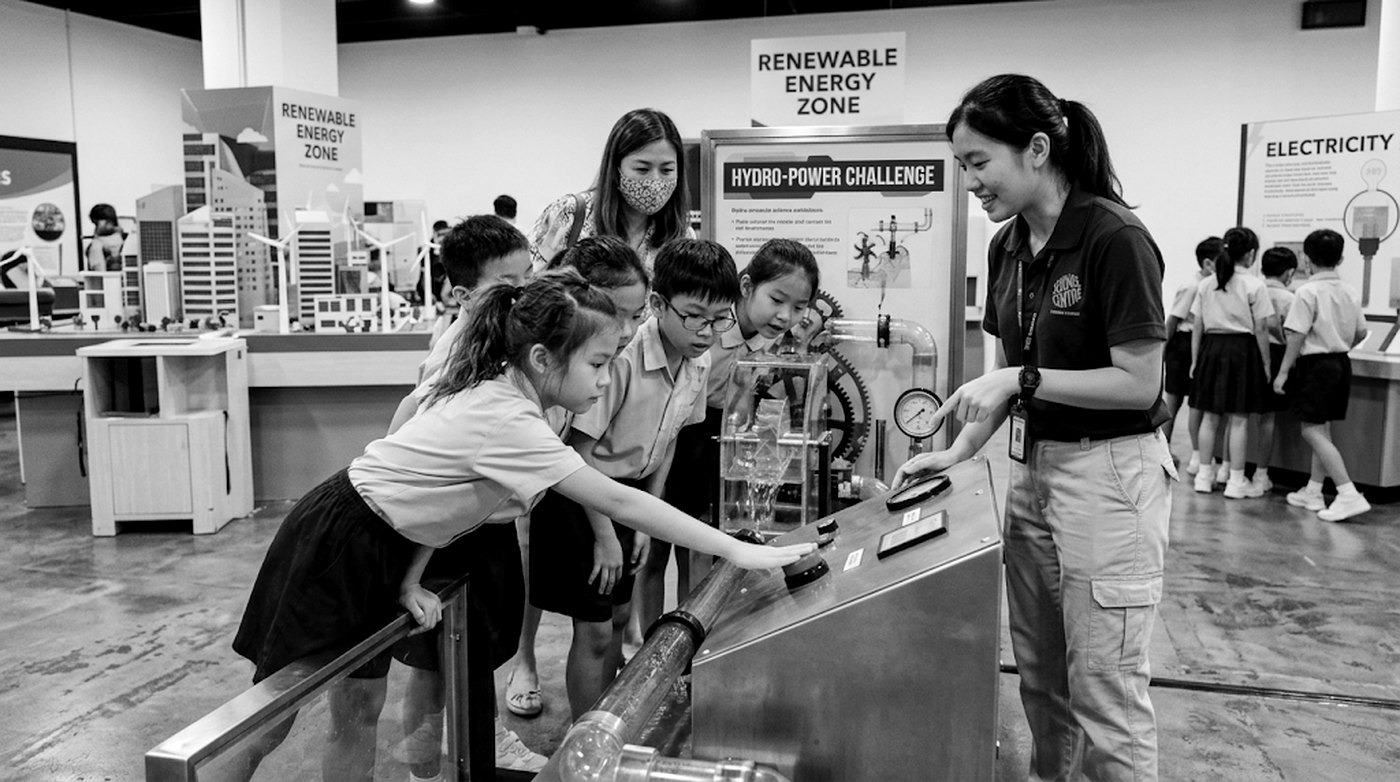
Look at the picture. What are the children doing at this exhibition?
Look, name, and explain what you see — then add one detail nobody else would notice.
0:00
Listen back. Did you…
Nothing is uploaded or saved — the recording stays on this device.
Model answer
In the picture, a group of primary school pupils are gathered around a hands-on exhibit at a science centre. One girl at the front is pressing a large red button while the others lean in to watch what will happen, and a guide in a green polo shirt is standing beside them pointing at a gauge. Behind them there is a model city with wind turbines and other exhibits along the wall. What I also noticed is that every one of them is looking at the machine rather than at the guide, so whatever is about to happen is more interesting than the explanation.
Why it scores
Picks the exact moment before something happens, and the closing observation about where everyone is looking says something true about how children actually learn.
Show the answer frame instead
Point to what you see"In the picture, a group of pupils are…" — name the activity.
Say what is about to happen"One girl is pressing…while the others…" — describe the moment.
Add one closer detail"What I also noticed is…" — this is what lifts a plain answer into a strong one.
Q2Relate it to yourself
Tell me about a school trip or exhibition you have been on. What do you remember about it?
Give a real example from your own life. Say what happened, then how you felt.
0:00
Listen back. Did you…
Nothing is uploaded or saved — the recording stays on this device.
Model answer
In Primary Four we went to the science centre and there was an exhibit where you pedalled a bicycle to light up a row of bulbs. I thought it would be easy, and I managed three bulbs before my legs gave out. The guide told us that lighting one bulb for an hour takes more effort than most people expect, and I have never forgotten that because I felt it in my legs rather than being told it. Now when I leave a light on in an empty room my mother does not even have to say anything.
Why it scores
The learning is physical and specific, and the ending shows the lesson stuck without announcing that it did.
Show the answer frame instead
Name the trip"In Primary Four we went to…" — say when and where.
Describe one exhibit"There was an exhibit where…" — one thing in detail beats a list.
Say what stayed with you"I have never forgotten…because…" — this is the part that scores.
Q3Give your opinion
Do you think children learn better by doing things themselves than by being told? Why?
Take a clear stand, give a reason, acknowledge the other side, then close.
0:00
Listen back. Did you…
Nothing is uploaded or saved — the recording stays on this device.
Model answer
I think we usually do, especially for anything that involves how something works. When you press the button yourself you find out what happens and you remember it, whereas if someone describes it you are only remembering their words. Doing it also lets you be wrong in a way that does not cost anything, which is how most people actually learn. I understand that this cannot be the whole of education, because there is a great deal you could never work out on your own — nobody discovers history by experiment, and there is not enough time to rediscover everything. However, I believe the best lessons are the ones where you are told just enough to try it yourself, and then left to try.
Why it scores
Defends hands-on learning with a real mechanism, concedes a strong counterexample rather than a token one, and closes on how the two fit together.
Show the answer frame instead
Take a clear stand"I think we usually do…" — never start with "maybe".
Give your strongest reason"When you do it yourself…" — explain why it works.
Show you see the other side"I understand that…however…" — a real counterexample, not a token one.
Close it"That is why I believe…" — a proper ending, not a trailing off.
Useful phrases for this topic
Frames your child can use while answering. Tap any phrase to copy it.
A hands-on exhibit…
Gathered around the display…
Pressing the button to see what happens…
A guide explaining how it works…
Learning by doing…
You remember what you tried yourself…
What I also noticed is…
This reminds me of the time when…
I understand why some people feel that way, however…
That is why I believe…
Common mistakes on this kind of question
Saying only "they are looking at a machine"Say what the machine does and what the children are about to do with it.
Forgetting the guideThe adult explaining is part of the scene and part of the answer.
A generic school trip answerPick one exhibit you actually remember. Details are what make it believable.
Answering in one line"Yes, I would." A full answer needs a reason and an example — aim for three or four sentences.
No reason givenEvery opinion needs a "because". Without it, the answer sounds like a guess.
Parent script — how to run this in 10 minutes
Show the picture. Say nothing for 30 seconds.
Ask Q1 exactly as written. Count to five in your head before you help.
After the answer, ask "why?" once more. That single word usually doubles the answer.
Repeat for the remaining questions.
Finish with one thing that was good and one thing to try next time. Only one of each.