All topics Arts, Culture & Heritage

🎨 Arts, Culture & Heritage ✍️ Full model answers

Learning a Traditional Instrument

Stimulus-based conversation practice · 3 questions · about 10 minutes

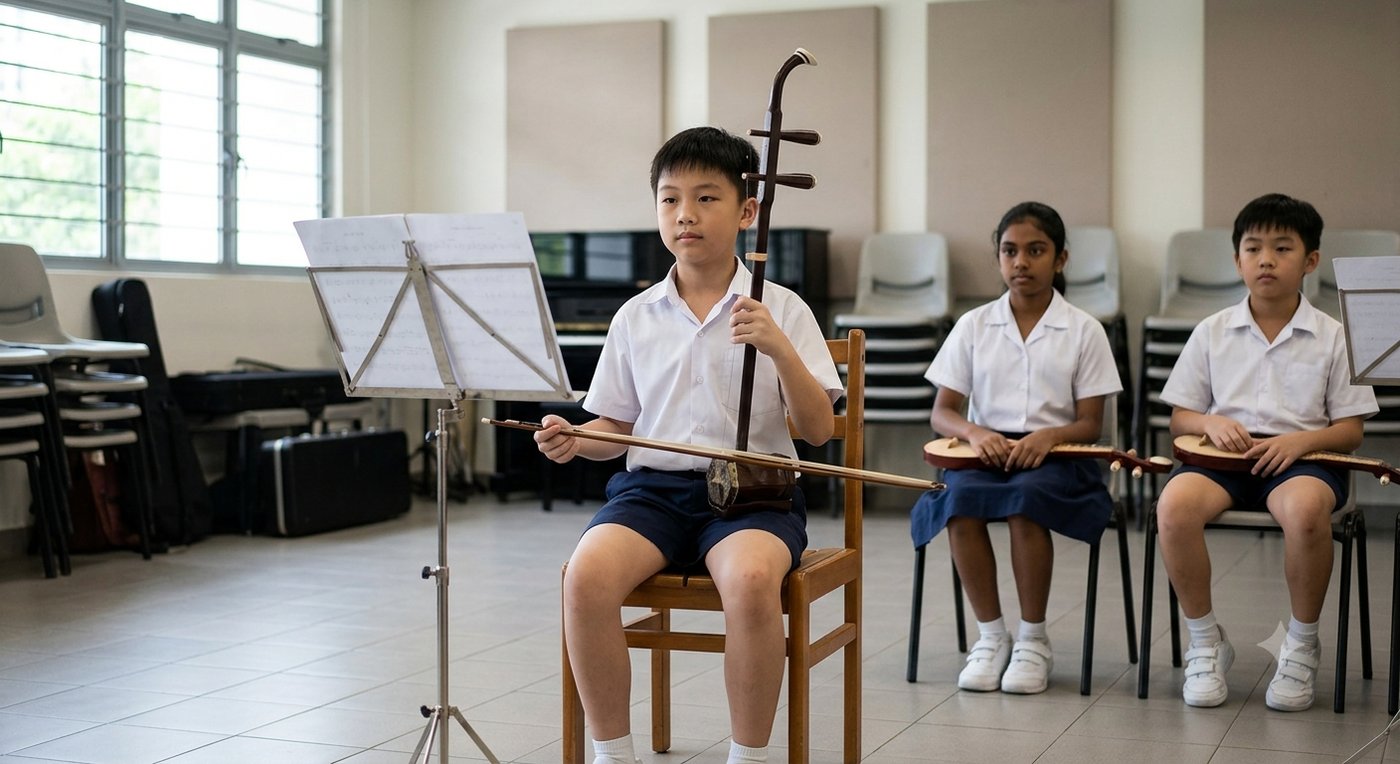
Learning a Traditional Instrument — PSLE oral stimulus picture
Let your child look at the picture for 30 seconds before the first question.

The questions

Ask these in order. Wait five full seconds after each one before helping — the silence is where the thinking happens.

Q1 Describe the stimulus

Look at the picture. What instrument is the student playing, and how can you tell?

Look, name, and explain what you see — then add one detail nobody else would notice.

0:00
Model answer

The student is holding an erhu, which is a traditional Chinese string instrument. I can tell because it has a long neck with a small round sound box at the bottom covered with skin, and it is played with a bow that sits between the two strings. She is holding it upright, resting on her lap, with the bow in her right hand. What I also noticed is that there is sheet music on a stand in front of her, so she is learning to read music as well as to play.

Why it scores

Identifies the instrument and proves it with three physical details — exactly what 'how can you tell' asks for.

Show the answer frame instead
  1. Point to what you see"In the picture, I can see…" — name two or three specific things, not just one.
  2. Explain what is happening"It looks like… because…" — link what you see to why it is happening.
  3. Add one closer detail"What I also noticed is…" — this is what lifts a plain answer into a strong one.

Q2 Relate it to yourself

Tell me about an instrument or art form you have tried to learn.

Give a real example from your own life. Say what happened, then how you felt.

0:00
Model answer

I tried learning the guzheng for about a year in Primary 4. What surprised me was how much my fingers hurt at first, because you pluck the strings with picks taped to your fingertips and the skin underneath gets sore. My teacher told me the soreness would pass once I built up calluses, and she was right, although I stopped after the year because of my studies. I still remember the first piece I could play from beginning to end without stopping.

Why it scores

An unexpected physical detail, an honest ending about stopping, and a fond final memory.

Show the answer frame instead
  1. Set the scene"This reminds me of the time when…" — say when and where in one line.
  2. Say what you did"What I did was…" — one clear action, not a list.
  3. Say how it felt or what you learnt"After that, I felt… because…" — examiners are listening for this part.
Q3 Give your opinion

Do you think traditional arts will survive among young Singaporeans? Why?

Take a clear stand, give a reason, acknowledge the other side, then close.

0:00
Model answer

I feel they will survive, but only if young people are given a reason to care about them. Fewer children take up traditional instruments today because there are so many other activities competing for their time, and these instruments take years to sound good. However, I have seen performances that combine the erhu or the angklung with modern music, and those make people my age listen properly instead of thinking it is old-fashioned. That is why I believe traditional arts survive not by staying exactly the same, but by finding new ways to be heard.

Why it scores

Realistic about the threat, gives a concrete example of what works, then closes with a genuinely mature idea.

Show the answer frame instead
  1. Take a clear stand"I feel that… / I agree that…" — never start with "maybe".
  2. Give your strongest reason"This is because…" — one solid reason beats three weak ones.
  3. Show you see the other side"I understand why some people feel that…, however…" — this shows maturity.
  4. Close it"That is why I believe…" — a proper ending, not a trailing off.

Useful phrases for this topic

Frames your child can use while answering these questions. Tap any phrase to copy it.

  • In the picture, I can see…
  • You can tell it is… because…
  • I have tried something similar when…
  • What I enjoy most about it is…
  • It is important to keep this because…
  • For young people today…
  • What I also noticed is…
  • This reminds me of the time when…
  • I understand why some people feel that way, however…
  • That is why I believe…

Common mistakes on this kind of question

Naming without describingSay how you can tell — the shape, the colour, the sound, the costume.
Saying it is "nice" or "interesting"Explain what specifically you enjoyed or noticed.
Forgetting why it mattersArts and heritage questions usually want a reason these things are worth keeping.
Answering in one line"Yes, I would." A full answer needs a reason and an example — aim for three or four sentences.
No reason givenEvery opinion needs a "because". Without it, the answer sounds like a guess.

Parent script — how to run this in 10 minutes

  1. Show the picture. Say nothing for 30 seconds.
  2. Ask Q1 exactly as written. Count to five in your head before you help.
  3. After the answer, ask "why?" once more. That single word usually doubles the answer.
  4. Repeat for the remaining questions.
  5. Finish with one thing that was good and one thing to try next time. Only one of each.

More topics like this

All 102 drills are free · No account · No payment

Want one picked for you each week?

Choosing between 102 drills at 8pm on a school night is its own problem. Leave your email and we will send one drill every Monday — nothing else, and you can stop any time.

One email a week. No spam, no sharing of your address.