All topics School & Education

🏫 School & Education ✍️ Full model answers

Mobile Phone Lockers

Stimulus-based conversation practice · 3 questions · about 10 minutes

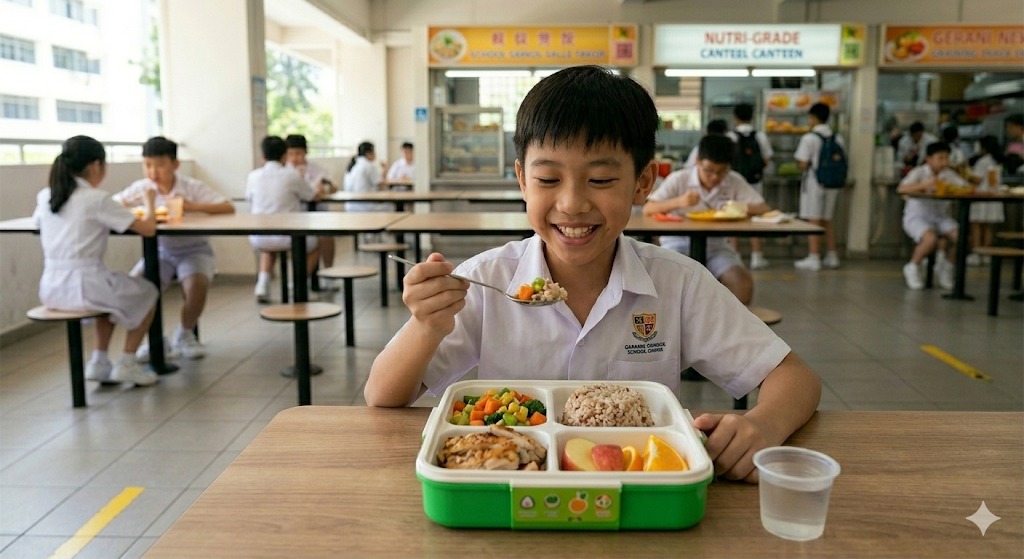
Mobile Phone Lockers — PSLE oral stimulus picture
Let your child look at the picture for 30 seconds before the first question.

The questions

Ask these in order. Wait five full seconds after each one before helping — the silence is where the thinking happens.

Q1 Describe the stimulus

Look at the picture. What are the students doing with their phones before class begins?

Look, name, and explain what you see — then add one detail nobody else would notice.

0:00
Model answer

In the picture, the students are placing their mobile phones into a locker or a pouch before class begins. Each slot appears to be numbered so that every student knows which one is theirs. The students are queuing up and doing it in an orderly way, so it seems to be a normal routine for them. What I also noticed is that some are taking a last quick look at their screens before putting the phones away.

Why it scores

Describes the system, the behaviour and one very human detail that shows careful observation.

Show the answer frame instead
  1. Point to what you see"In the picture, I can see…" — name two or three specific things, not just one.
  2. Explain what is happening"It looks like… because…" — link what you see to why it is happening.
  3. Add one closer detail"What I also noticed is…" — this is what lifts a plain answer into a strong one.
Q2 Relate it to yourself

Do you bring a phone to school? Tell me how you use it during the school day.

Give a real example from your own life. Say what happened, then how you felt.

0:00
Model answer

Yes, I do bring a phone to school. I mainly use it to message my mother when I finish CCA so that she knows what time to fetch me, and sometimes to check the bus arrival timing. During lessons it stays inside my bag, because our school does not allow phones to be used in class. I will admit that it is quite tempting to check it during recess, but I try to leave it alone so that I can talk to my friends instead.

Why it scores

Specific uses, an admission of temptation, and a personal rule — far stronger than 'I use it for emergencies'.

Show the answer frame instead
  1. Set the scene"This reminds me of the time when…" — say when and where in one line.
  2. Say what you did"What I did was…" — one clear action, not a list.
  3. Say how it felt or what you learnt"After that, I felt… because…" — examiners are listening for this part.
Q3 Give your opinion

Do you think students should be allowed to keep their phones with them in class? Why or why not?

Take a clear stand, give a reason, acknowledge the other side, then close.

0:00
Model answer

I feel students should be allowed to bring phones but not keep them during lessons. Having a phone is useful for contacting parents after school or in an emergency, and many students travel home on their own. However, if the phone is on the table during a lesson, even one notification is enough to break your concentration, and it is very hard to resist checking. That is why I believe a locker system is a fair solution, because it keeps the safety benefit without the distraction.

Why it scores

Takes a nuanced position, gives both sides properly, then names a specific solution instead of ending vaguely.

Show the answer frame instead
  1. Take a clear stand"I feel that… / I agree that…" — never start with "maybe".
  2. Give your strongest reason"This is because…" — one solid reason beats three weak ones.
  3. Show you see the other side"I understand why some people feel that…, however…" — this shows maturity.
  4. Close it"That is why I believe…" — a proper ending, not a trailing off.

Useful phrases for this topic

Frames your child can use while answering these questions. Tap any phrase to copy it.

  • In the picture, the student is…
  • This often happens in school when…
  • In my own experience…
  • What I would do differently is…
  • A better way would be to…
  • It teaches us that…
  • What I also noticed is…
  • This reminds me of the time when…
  • I understand why some people feel that way, however…
  • That is why I believe…

Common mistakes on this kind of question

Blaming someoneAnswers that point fingers score lower than ones that suggest what could be done.
A story with no consequenceSay what happened afterwards — that is where the learning shows.
Answering as an adultSpeak as a student. Your own school experience is exactly what is being asked for.
Answering in one line"Yes, I would." A full answer needs a reason and an example — aim for three or four sentences.
No reason givenEvery opinion needs a "because". Without it, the answer sounds like a guess.

Parent script — how to run this in 10 minutes

  1. Show the picture. Say nothing for 30 seconds.
  2. Ask Q1 exactly as written. Count to five in your head before you help.
  3. After the answer, ask "why?" once more. That single word usually doubles the answer.
  4. Repeat for the remaining questions.
  5. Finish with one thing that was good and one thing to try next time. Only one of each.

More topics like this

All 102 drills are free · No account · No payment

Want one picked for you each week?

Choosing between 102 drills at 8pm on a school night is its own problem. Leave your email and we will send one drill every Monday — nothing else, and you can stop any time.

One email a week. No spam, no sharing of your address.