All topics Technology & Innovation

💻 Technology & Innovation ⭐ Exam favourite ✍️ Full model answers

Online Lessons at Home

Stimulus-based conversation practice · 3 questions · about 10 minutes

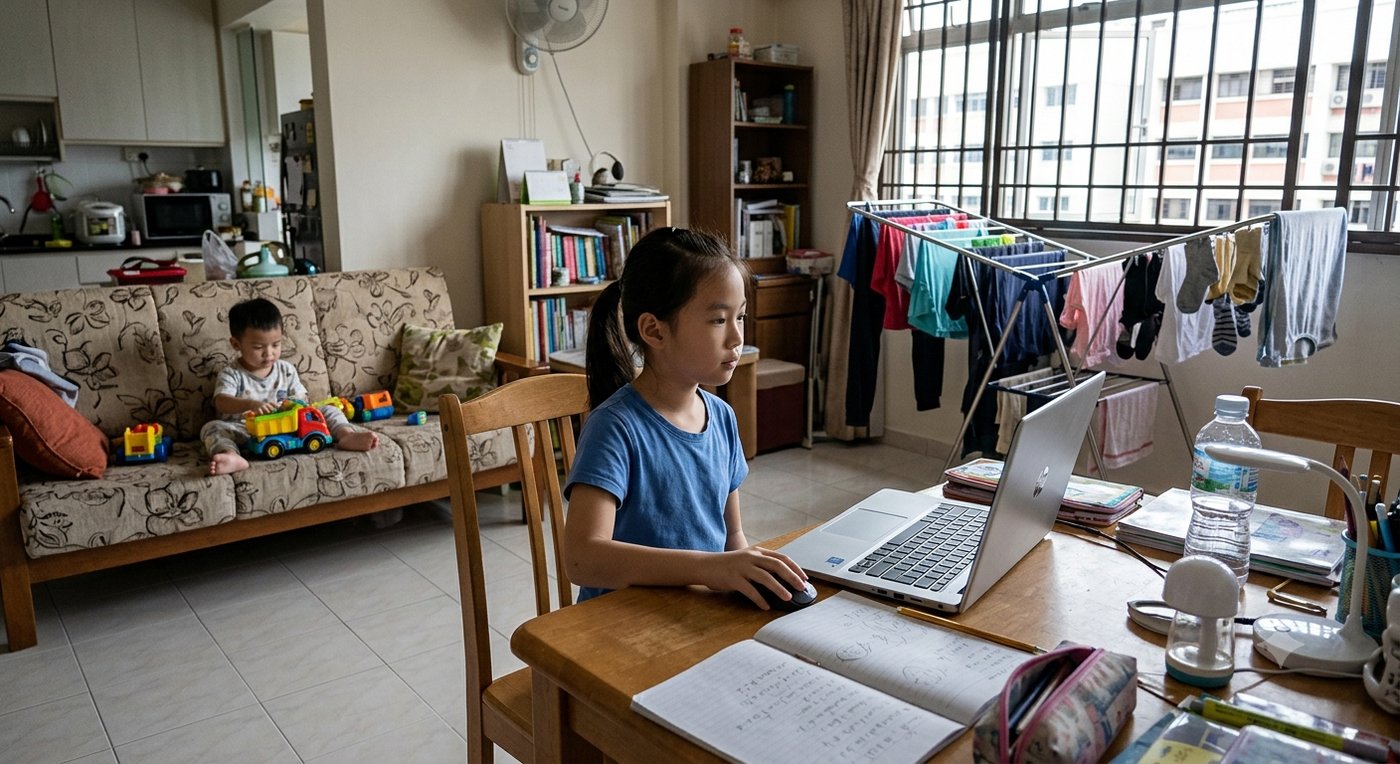
Online Lessons at Home — PSLE oral stimulus picture
Let your child look at the picture for 30 seconds before the first question.

The questions

Ask these in order. Wait five full seconds after each one before helping — the silence is where the thinking happens.

Q1 Describe the stimulus

Look at the picture. What is the child doing, and what makes it difficult?

Look, name, and explain what you see — then add one detail nobody else would notice.

0:00
Model answer

In the picture, the child is attending an online lesson at the dining table, facing a laptop that shows a grid of classmates on screen. Several things in the room could make it difficult to concentrate. A younger sibling is playing with a toy on the sofa behind, there is laundry drying on a rack nearby, and the dining table is also being used for other things. What I also noticed is that the child has no proper desk or quiet corner, so the lesson is happening in the middle of family life.

Why it scores

Answers both halves, listing three specific distractions, then summarises the underlying problem.

Show the answer frame instead
  1. Point to what you see"In the picture, I can see…" — name two or three specific things, not just one.
  2. Explain what is happening"It looks like… because…" — link what you see to why it is happening.
  3. Add one closer detail"What I also noticed is…" — this is what lifts a plain answer into a strong one.

Q2 Relate it to yourself

Tell me about your experience with home-based learning.

Give a real example from your own life. Say what happened, then how you felt.

0:00
Model answer

During home-based learning, I found the lessons themselves quite manageable but everything around them harder. My younger brother would come and ask questions in the middle of a lesson, and once he appeared on camera in his pyjamas, which my whole class saw. I also found it difficult to ask questions, because unmuting felt like interrupting in a way that raising a hand in class does not. What I did enjoy was not having to wake up so early to catch the bus.

Why it scores

Specific and funny, names a real subtle difficulty, and gives an honest positive at the end.

Show the answer frame instead
  1. Set the scene"This reminds me of the time when…" — say when and where in one line.
  2. Say what you did"What I did was…" — one clear action, not a list.
  3. Say how it felt or what you learnt"After that, I felt… because…" — examiners are listening for this part.
Q3 Give your opinion

Do you think learning at home is as effective as learning in school? Why?

Take a clear stand, give a reason, acknowledge the other side, then close.

0:00
Model answer

I feel it is not quite as effective, although it works better for some things than others. Watching a lesson at home can be fine for topics that are mostly explanation, and you can replay a recording if you missed something. However, it is much harder to ask questions, to work with classmates, or for a teacher to notice that you look confused. Most importantly, learning in school also teaches things beyond the subject, such as getting along with others, and a screen cannot really replace that.

Why it scores

Concedes what home learning does well before explaining what is lost, closing on the non-academic point.

Show the answer frame instead
  1. Take a clear stand"I feel that… / I agree that…" — never start with "maybe".
  2. Give your strongest reason"This is because…" — one solid reason beats three weak ones.
  3. Show you see the other side"I understand why some people feel that…, however…" — this shows maturity.
  4. Close it"That is why I believe…" — a proper ending, not a trailing off.

Useful phrases for this topic

Frames your child can use while answering these questions. Tap any phrase to copy it.

  • In the picture, the device is being used to…
  • This makes things easier because…
  • However, one problem with this is…
  • I have used something similar when…
  • Used properly, it can…
  • It depends on how we use it, because…
  • What I also noticed is…
  • This reminds me of the time when…
  • I understand why some people feel that way, however…
  • That is why I believe…

Common mistakes on this kind of question

Only praising the technologyA strong answer names one drawback too — that is what shows balanced thinking.
Naming the device but not its useSay what the technology actually does for the person using it.
Forgetting peopleTechnology topics are really about people — who is helped, and who is left behind.
Answering in one line"Yes, I would." A full answer needs a reason and an example — aim for three or four sentences.
No reason givenEvery opinion needs a "because". Without it, the answer sounds like a guess.

Parent script — how to run this in 10 minutes

  1. Show the picture. Say nothing for 30 seconds.
  2. Ask Q1 exactly as written. Count to five in your head before you help.
  3. After the answer, ask "why?" once more. That single word usually doubles the answer.
  4. Repeat for the remaining questions.
  5. Finish with one thing that was good and one thing to try next time. Only one of each.

More topics like this

All 102 drills are free · No account · No payment

Want one picked for you each week?

Choosing between 102 drills at 8pm on a school night is its own problem. Leave your email and we will send one drill every Monday — nothing else, and you can stop any time.

One email a week. No spam, no sharing of your address.