All topics Family & Home

🏠 Family & Home ⭐ Exam favourite ✍️ Full model answers

Preparing Diner At Home

Stimulus-based conversation practice · 3 questions · about 10 minutes

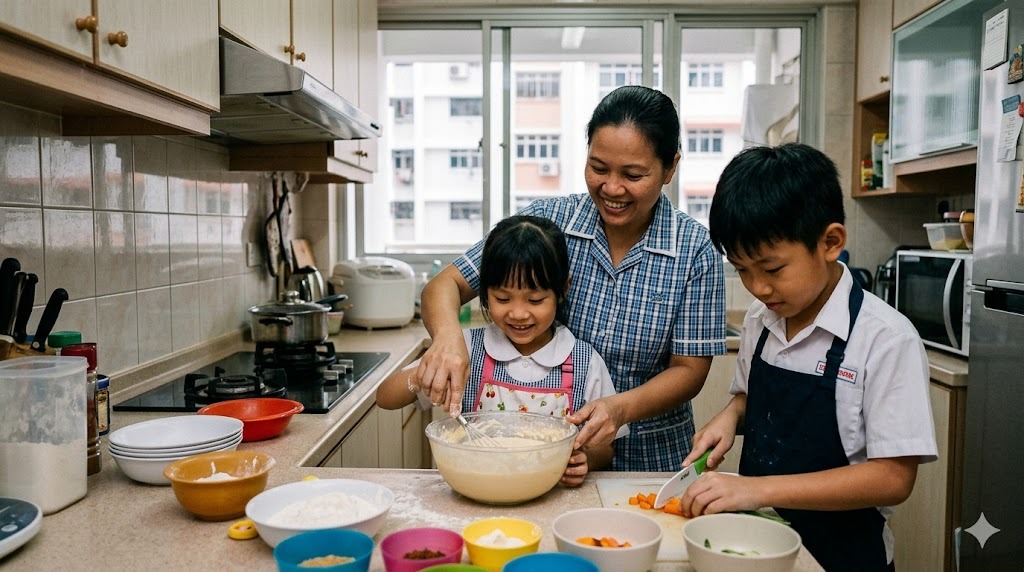
Preparing Diner At Home — PSLE oral stimulus picture
Let your child look at the picture for 30 seconds before the first question.

The questions

Ask these in order. Wait five full seconds after each one before helping — the silence is where the thinking happens.

Q1 Describe the stimulus

Look at the picture. What are the family members preparing in the kitchen?

Look, name, and explain what you see — then add one detail nobody else would notice.

0:00
Model answer

In the picture, the family is preparing dinner together in the kitchen. The mother is at the stove stirring something in a wok, a child is washing vegetables at the sink, and another is setting out plates and bowls on the counter. There are cut ingredients arranged on a chopping board ready to be used. What I also noticed is that each person has a task suited to their age, so even the youngest is helping without being near the hot stove.

Why it scores

Names each person's task and then notices the sensible division by age and safety.

Show the answer frame instead
  1. Point to what you see"In the picture, I can see…" — name two or three specific things, not just one.
  2. Explain what is happening"It looks like… because…" — link what you see to why it is happening.
  3. Add one closer detail"What I also noticed is…" — this is what lifts a plain answer into a strong one.

Q2 Relate it to yourself

Tell me about a dish you have helped to cook, or would like to learn to cook.

Give a real example from your own life. Say what happened, then how you felt.

0:00
Model answer

I have learnt to cook scrambled eggs and instant noodles, and recently my grandmother started teaching me how to make steamed egg. The tricky part is the ratio of water to egg, and my first attempt came out watery because I added too much. She told me to use the same eggshell to measure the water, which is how she has always done it. It worked, and now I make it for my sister on weekends when my parents are out.

Why it scores

A real technique from a grandparent, a failure and a fix, ending with the skill actually being used.

Show the answer frame instead
  1. Set the scene"This reminds me of the time when…" — say when and where in one line.
  2. Say what you did"What I did was…" — one clear action, not a list.
  3. Say how it felt or what you learnt"After that, I felt… because…" — examiners are listening for this part.
Q3 Give your opinion

Do you think children should learn to cook, even when they are busy with schoolwork? Why?

Take a clear stand, give a reason, acknowledge the other side, then close.

0:00
Model answer

Yes, I feel they should. Cooking is a skill everyone eventually needs, and it is much easier to learn while someone is there to teach you than to work it out alone as an adult. It also helps us appreciate the effort behind every meal, and it is a way of caring for others, since cooking for someone is a kind of gift. I understand that schoolwork takes up a lot of time, however learning one dish properly during a holiday does not take much time at all, and the skill lasts for life.

Why it scores

Three reasons including an emotional one, then handles the time objection with a practical suggestion.

Show the answer frame instead
  1. Take a clear stand"I feel that… / I agree that…" — never start with "maybe".
  2. Give your strongest reason"This is because…" — one solid reason beats three weak ones.
  3. Show you see the other side"I understand why some people feel that…, however…" — this shows maturity.
  4. Close it"That is why I believe…" — a proper ending, not a trailing off.

Useful phrases for this topic

Frames your child can use while answering these questions. Tap any phrase to copy it.

  • In the picture, they are…
  • In my family, we usually…
  • This matters because…
  • One thing I have learnt at home is…
  • It may be a small thing, but…
  • That is our way of showing…
  • What I also noticed is…
  • This reminds me of the time when…
  • I understand why some people feel that way, however…
  • That is why I believe…

Common mistakes on this kind of question

Giving a perfect-family answerReal detail — the chore you dislike, the argument, the small habit — sounds far more believable.
Saying "we spend time together" and stoppingName what you actually do together, and when.
Missing the feelingFamily topics score best when you say why it matters to you, not only what happens.
Answering in one line"Yes, I would." A full answer needs a reason and an example — aim for three or four sentences.
No reason givenEvery opinion needs a "because". Without it, the answer sounds like a guess.

Parent script — how to run this in 10 minutes

  1. Show the picture. Say nothing for 30 seconds.
  2. Ask Q1 exactly as written. Count to five in your head before you help.
  3. After the answer, ask "why?" once more. That single word usually doubles the answer.
  4. Repeat for the remaining questions.
  5. Finish with one thing that was good and one thing to try next time. Only one of each.

More topics like this

All 102 drills are free · No account · No payment

Want one picked for you each week?

Choosing between 102 drills at 8pm on a school night is its own problem. Leave your email and we will send one drill every Monday — nothing else, and you can stop any time.

One email a week. No spam, no sharing of your address.