All topics Arts, Culture & Heritage

🎨 Arts, Culture & Heritage ⭐ Exam favourite ✍️ Full model answers

Robotics Classroom

Stimulus-based conversation practice · 3 questions · about 10 minutes

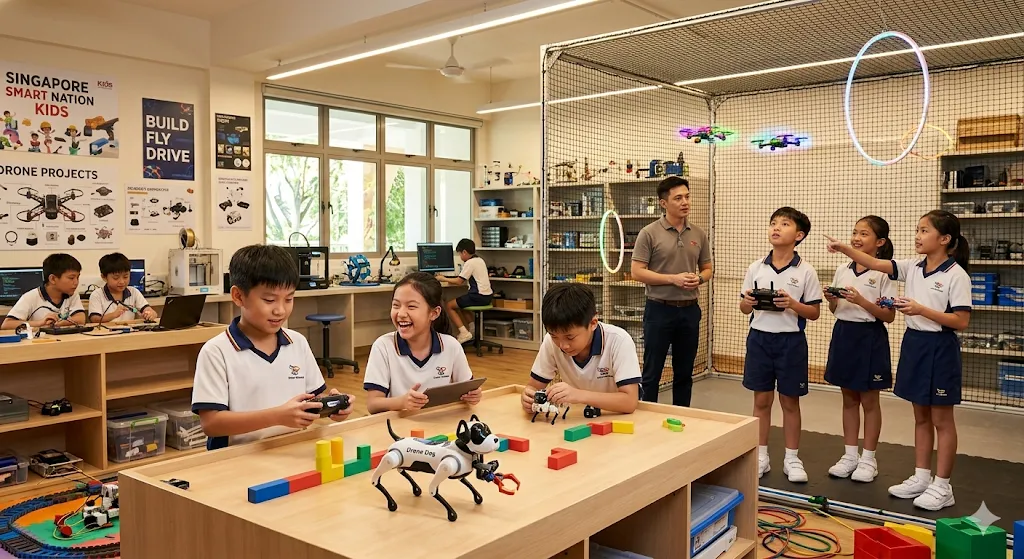
Robotics Classroom — PSLE oral stimulus picture
Let your child look at the picture for 30 seconds before the first question.

The questions

Ask these in order. Wait five full seconds after each one before helping — the silence is where the thinking happens.

Q1 Describe the stimulus

Look at the picture. What are the students doing in the robotics room?

Look, name, and explain what you see — then add one detail nobody else would notice.

0:00
Model answer

In the picture, the students are working on robotics in a specially set-up classroom. Some are assembling a small robot with wheels and sensors, while others are at a laptop writing or testing the code that controls it. There are spare parts, wires and tools spread across the table. What I also noticed is that one group's robot appears to have stopped moving and they are gathered around discussing it, so they are troubleshooting rather than following instructions exactly.

Why it scores

Describes both the building and the coding, then spots the problem-solving moment — the best detail in the scene.

Show the answer frame instead
  1. Point to what you see"In the picture, I can see…" — name two or three specific things, not just one.
  2. Explain what is happening"It looks like… because…" — link what you see to why it is happening.
  3. Add one closer detail"What I also noticed is…" — this is what lifts a plain answer into a strong one.

Q2 Relate it to yourself

Tell me about a CCA or club activity you enjoy. Why do you like it?

Give a real example from your own life. Say what happened, then how you felt.

0:00
Model answer

I am in the Infocomm Club, and what I enjoy most is that we get to make things that actually work rather than only learn about them. Last term we built a simple line-following robot, and ours kept veering off the track until we realised the sensor was set too high above the ground. Lowering it by about a centimetre fixed everything, which felt like a small miracle after an hour of trying. I like that in this CCA, being stuck is normal and figuring it out is the whole point.

Why it scores

Specific problem, specific fix, and a closing line that shows real understanding of what the activity teaches.

Show the answer frame instead
  1. Set the scene"This reminds me of the time when…" — say when and where in one line.
  2. Say what you did"What I did was…" — one clear action, not a list.
  3. Say how it felt or what you learnt"After that, I felt… because…" — examiners are listening for this part.
Q3 Give your opinion

Do you think technology makes learning easier or more difficult for students? Why?

Take a clear stand, give a reason, acknowledge the other side, then close.

0:00
Model answer

I feel technology makes learning easier in some ways and harder in others. It is easier because information is instantly available and difficult ideas can be shown as animations or simulations instead of only words. It is harder because the same device offers endless distractions, and because having answers so quickly can stop us from struggling with a problem long enough to really learn it. That is why I believe technology is a very good tool but a poor teacher, and how we use it matters more than how much of it we have.

Why it scores

Balanced with a specific reason each way, closing on a memorable distinction between tool and teacher.

Show the answer frame instead
  1. Take a clear stand"I feel that… / I agree that…" — never start with "maybe".
  2. Give your strongest reason"This is because…" — one solid reason beats three weak ones.
  3. Show you see the other side"I understand why some people feel that…, however…" — this shows maturity.
  4. Close it"That is why I believe…" — a proper ending, not a trailing off.

Useful phrases for this topic

Frames your child can use while answering these questions. Tap any phrase to copy it.

  • In the picture, I can see…
  • You can tell it is… because…
  • I have tried something similar when…
  • What I enjoy most about it is…
  • It is important to keep this because…
  • For young people today…
  • What I also noticed is…
  • This reminds me of the time when…
  • I understand why some people feel that way, however…
  • That is why I believe…

Common mistakes on this kind of question

Naming without describingSay how you can tell — the shape, the colour, the sound, the costume.
Saying it is "nice" or "interesting"Explain what specifically you enjoyed or noticed.
Forgetting why it mattersArts and heritage questions usually want a reason these things are worth keeping.
Answering in one line"Yes, I would." A full answer needs a reason and an example — aim for three or four sentences.
No reason givenEvery opinion needs a "because". Without it, the answer sounds like a guess.

Parent script — how to run this in 10 minutes

  1. Show the picture. Say nothing for 30 seconds.
  2. Ask Q1 exactly as written. Count to five in your head before you help.
  3. After the answer, ask "why?" once more. That single word usually doubles the answer.
  4. Repeat for the remaining questions.
  5. Finish with one thing that was good and one thing to try next time. Only one of each.

More topics like this

All 102 drills are free · No account · No payment

Want one picked for you each week?

Choosing between 102 drills at 8pm on a school night is its own problem. Leave your email and we will send one drill every Monday — nothing else, and you can stop any time.

One email a week. No spam, no sharing of your address.