All topics Environment & Sustainability

🌱 Environment & Sustainability ⭐ Exam favourite ✍️ Full model answers

Second-Hand Book Fair

Stimulus-based conversation practice · 3 questions · about 10 minutes

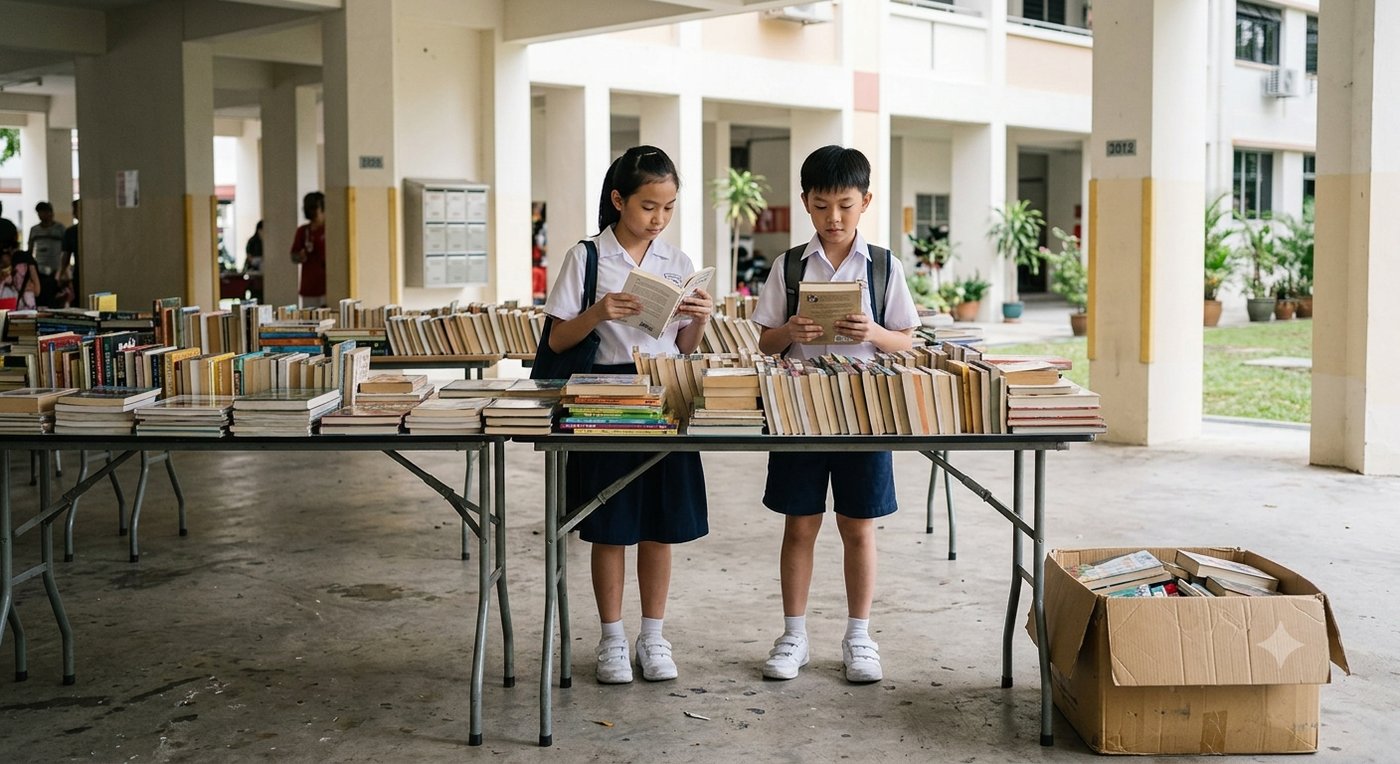
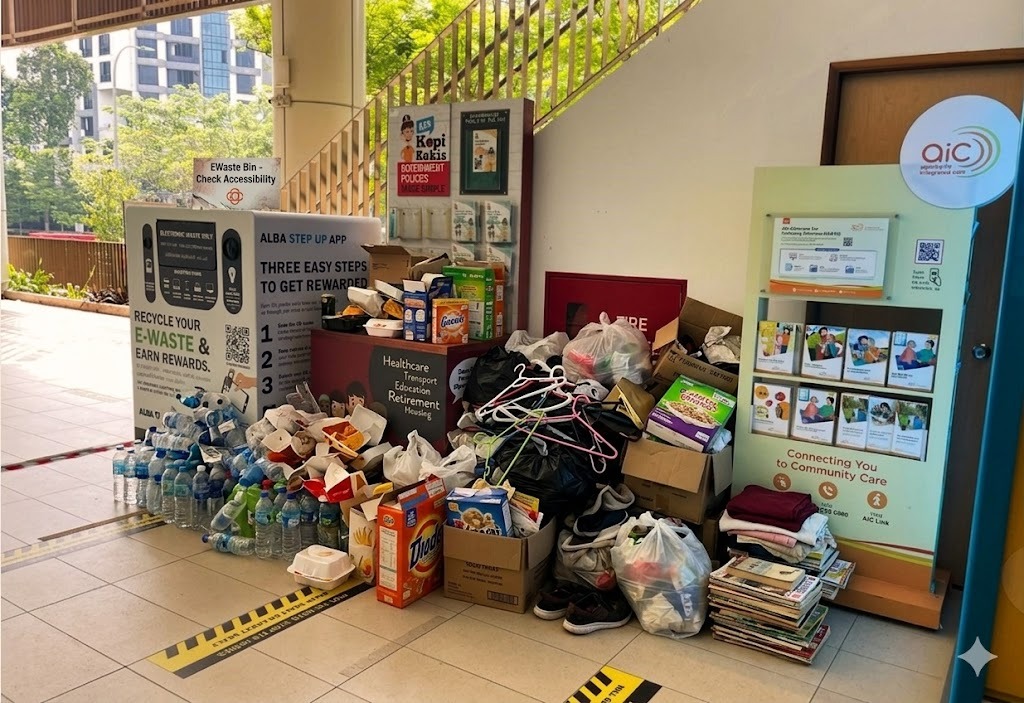
Second-Hand Book Fair — PSLE oral stimulus picture
Let your child look at the picture for 30 seconds before the first question.

The questions

Ask these in order. Wait five full seconds after each one before helping — the silence is where the thinking happens.

Q1 Describe the stimulus

Look at the picture. What is happening at this second-hand book fair?

Look, name, and explain what you see — then add one detail nobody else would notice.

0:00
Model answer

In the picture, a second-hand book fair is being held at a void deck. Long tables are covered with used books arranged in rows, and two primary school students are standing at the table, each reading a book they have picked up. There is also a cardboard box of donated books on the ground beside the table. What I also noticed is that the books are in good condition, so they have been well kept by their previous owners.

Why it scores

Names the setting and the activity, then makes an observation about the books that shows careful looking.

Show the answer frame instead
  1. Point to what you see"In the picture, I can see…" — name two or three specific things, not just one.
  2. Explain what is happening"It looks like… because…" — link what you see to why it is happening.
  3. Add one closer detail"What I also noticed is…" — this is what lifts a plain answer into a strong one.
Q2 Relate it to yourself

Tell me about a book, toy or item you have passed on to someone else.

Give a real example from your own life. Say what happened, then how you felt.

0:00
Model answer

I passed on a whole box of my old storybooks to my younger cousin last year. Some of them were the ones I had read many times, so it was a little difficult to give them away, especially the series I finished in Primary 3. My mother reminded me that they had been sitting in my cupboard untouched for two years. When my cousin messaged me later to say she had finished the first one, I was glad I had let them go.

Why it scores

Admits the reluctance honestly, then closes with a small moment that shows why giving was worth it.

Show the answer frame instead
  1. Set the scene"This reminds me of the time when…" — say when and where in one line.
  2. Say what you did"What I did was…" — one clear action, not a list.
  3. Say how it felt or what you learnt"After that, I felt… because…" — examiners are listening for this part.
Q3 Give your opinion

Do you think buying second-hand is better than buying new? Why?

Take a clear stand, give a reason, acknowledge the other side, then close.

0:00
Model answer

I feel buying second-hand is often just as good. A book contains exactly the same story whether it is new or used, and buying second-hand costs much less, which means a family can afford more books for the same money. It is also better for the environment, since fewer new books need to be printed. However, I understand that some people prefer new items for things like shoes or school supplies, so I feel it depends on what is being bought.

Why it scores

Three reasons then a sensible limit, which is more convincing than claiming second-hand is always better.

Show the answer frame instead
  1. Take a clear stand"I feel that… / I agree that…" — never start with "maybe".
  2. Give your strongest reason"This is because…" — one solid reason beats three weak ones.
  3. Show you see the other side"I understand why some people feel that…, however…" — this shows maturity.
  4. Close it"That is why I believe…" — a proper ending, not a trailing off.

Useful phrases for this topic

Frames your child can use while answering these questions. Tap any phrase to copy it.

  • In the picture, I can see that…
  • This is wasteful because…
  • A small change we could make is…
  • At home, my family tries to…
  • If everyone did this, then…
  • It may seem small, but…
  • What I also noticed is…
  • This reminds me of the time when…
  • I understand why some people feel that way, however…
  • That is why I believe…

Common mistakes on this kind of question

Describing without judgingThe question usually asks whether something is right or wasteful. Say what you think, not only what you see.
Vague solutions"We should recycle more" says nothing. Name one specific action a family could actually do.
Forgetting the local angleMentioning Singapore's own situation — imported food, limited land, Semakau Landfill — lifts an ordinary answer.
Answering in one line"Yes, I would." A full answer needs a reason and an example — aim for three or four sentences.
No reason givenEvery opinion needs a "because". Without it, the answer sounds like a guess.

Parent script — how to run this in 10 minutes

  1. Show the picture. Say nothing for 30 seconds.
  2. Ask Q1 exactly as written. Count to five in your head before you help.
  3. After the answer, ask "why?" once more. That single word usually doubles the answer.
  4. Repeat for the remaining questions.
  5. Finish with one thing that was good and one thing to try next time. Only one of each.

More topics like this

All 102 drills are free · No account · No payment

Want one picked for you each week?

Choosing between 102 drills at 8pm on a school night is its own problem. Leave your email and we will send one drill every Monday — nothing else, and you can stop any time.

One email a week. No spam, no sharing of your address.