All topics Community & Social Responsibility

🤝 Community & Social Responsibility ⭐ Exam favourite ✍️ Full model answers

Sharing an Umbrella

Stimulus-based conversation practice · 3 questions · about 10 minutes

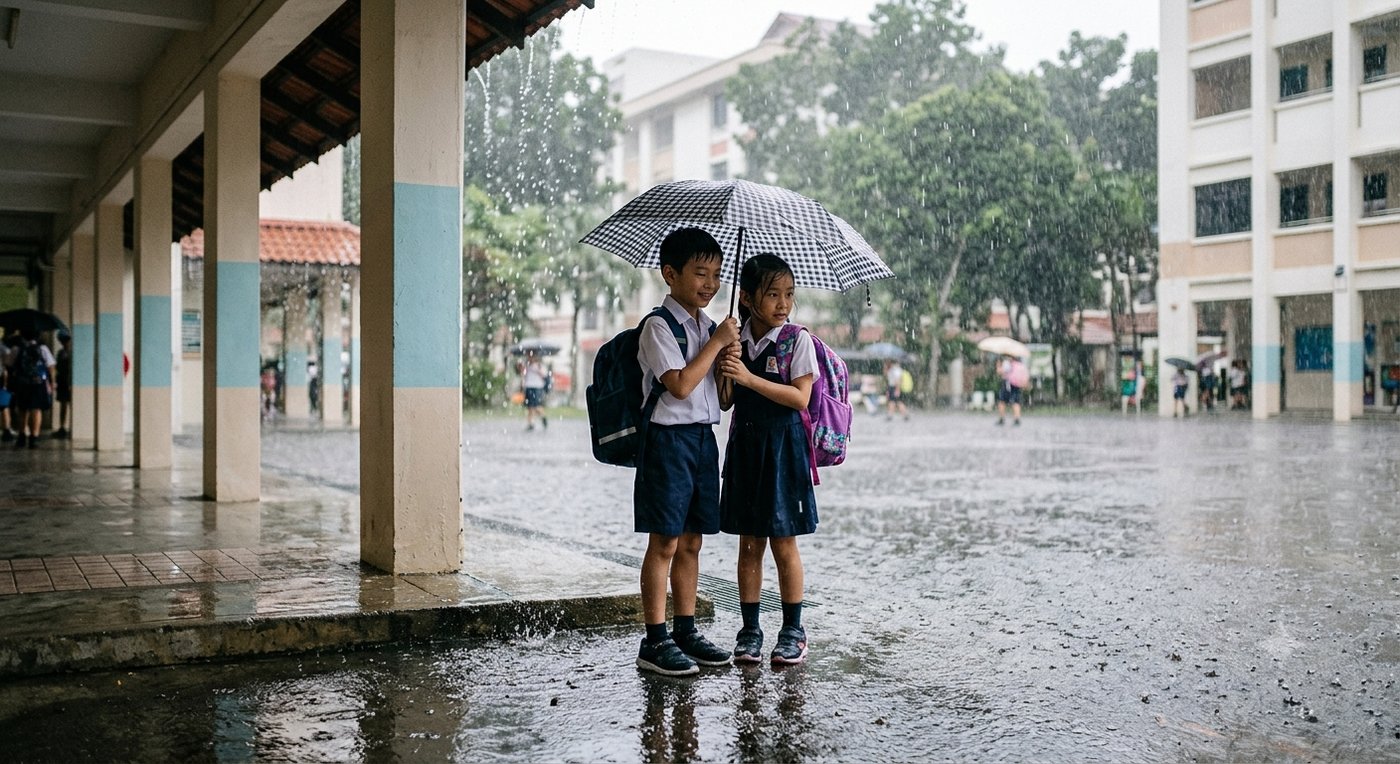
Sharing an Umbrella — PSLE oral stimulus picture
Let your child look at the picture for 30 seconds before the first question.

The questions

Ask these in order. Wait five full seconds after each one before helping — the silence is where the thinking happens.

Q1 Describe the stimulus

Look at the picture. What are the two students doing during the rain?

Look, name, and explain what you see — then add one detail nobody else would notice.

0:00
Model answer

In the picture, two primary school students are sheltering under a single umbrella at the edge of a covered walkway while it rains heavily. They are standing close together so that both stay under it, with their school bags on their backs. The ground around them is wet and rain is falling steadily. What I also noticed is that one of them is holding the umbrella tilted towards the other, so he is keeping his friend dry even though part of his own shoulder is getting wet.

Why it scores

The tilted umbrella detail is the whole story — spotting it is what makes this a strong answer.

Show the answer frame instead
  1. Point to what you see"In the picture, I can see…" — name two or three specific things, not just one.
  2. Explain what is happening"It looks like… because…" — link what you see to why it is happening.
  3. Add one closer detail"What I also noticed is…" — this is what lifts a plain answer into a strong one.

Q2 Relate it to yourself

Tell me about a time a friend helped you out of a small difficulty.

Give a real example from your own life. Say what happened, then how you felt.

0:00
Model answer

This reminds me of a time I forgot my wallet on an excursion day and had no money for lunch. I did not tell anyone because I felt embarrassed, but my friend noticed I was not buying anything and simply bought an extra packet of noodles and put it in front of me without making it a big thing. He never mentioned it again afterwards. I have never forgotten that, mostly because of the way he did it rather than what he gave me.

Why it scores

The kindness is in the manner, not the act, and the closing line names that precisely.

Show the answer frame instead
  1. Set the scene"This reminds me of the time when…" — say when and where in one line.
  2. Say what you did"What I did was…" — one clear action, not a list.
  3. Say how it felt or what you learnt"After that, I felt… because…" — examiners are listening for this part.
Q3 Give your opinion

Why do you think small acts of kindness are remembered for a long time?

Take a clear stand, give a reason, acknowledge the other side, then close.

0:00
Model answer

I feel small acts of kindness are remembered because they are unexpected. Nobody has to share an umbrella or buy someone lunch, so when a person does it anyway, it tells you something about who they are rather than about what was required. They also usually happen when we are struggling, and we remember how people treated us at those moments far more clearly than at ordinary times. Most importantly, a small kindness tells us that someone noticed us, and being noticed is something people remember for a very long time.

Why it scores

Three reasons of increasing depth, closing on an idea that is genuinely moving.

Show the answer frame instead
  1. Take a clear stand"I feel that… / I agree that…" — never start with "maybe".
  2. Give your strongest reason"This is because…" — one solid reason beats three weak ones.
  3. Show you see the other side"I understand why some people feel that…, however…" — this shows maturity.
  4. Close it"That is why I believe…" — a proper ending, not a trailing off.

Useful phrases for this topic

Frames your child can use while answering these questions. Tap any phrase to copy it.

  • In the picture, I can see…
  • This shows consideration because…
  • I remember a time when…
  • In my neighbourhood…
  • If more people did this…
  • It costs us very little to…
  • What I also noticed is…
  • This reminds me of the time when…
  • I understand why some people feel that way, however…
  • That is why I believe…

Common mistakes on this kind of question

Missing what is wrong in the pictureLook for the one detail that shows consideration — or the lack of it.
Judging harshlyAssuming people are lazy or rude sounds less mature than considering why they behaved that way.
General advice with no example"People should be more gracious" needs a real moment from your own life to support it.
Answering in one line"Yes, I would." A full answer needs a reason and an example — aim for three or four sentences.
No reason givenEvery opinion needs a "because". Without it, the answer sounds like a guess.

Parent script — how to run this in 10 minutes

  1. Show the picture. Say nothing for 30 seconds.
  2. Ask Q1 exactly as written. Count to five in your head before you help.
  3. After the answer, ask "why?" once more. That single word usually doubles the answer.
  4. Repeat for the remaining questions.
  5. Finish with one thing that was good and one thing to try next time. Only one of each.

More topics like this

All 102 drills are free · No account · No payment

Want one picked for you each week?

Choosing between 102 drills at 8pm on a school night is its own problem. Leave your email and we will send one drill every Monday — nothing else, and you can stop any time.

One email a week. No spam, no sharing of your address.