All topics Community & Social Responsibility

🤝 Community & Social Responsibility ⭐ Exam favourite ✍️ Full model answers

The MRT Breakdown

Stimulus-based conversation practice · 3 questions · about 10 minutes

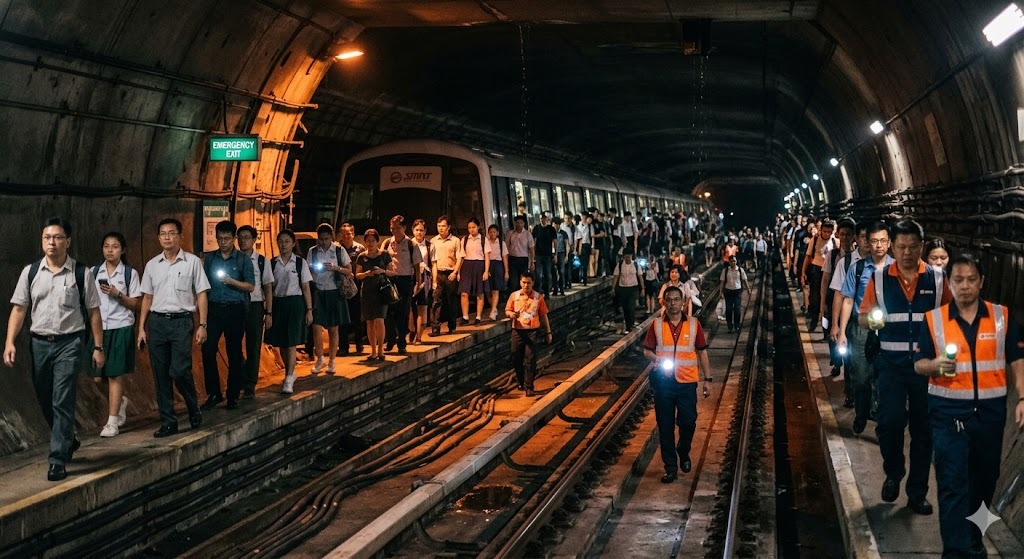
The MRT Breakdown — PSLE oral stimulus picture
Let your child look at the picture for 30 seconds before the first question.

The questions

Ask these in order. Wait five full seconds after each one before helping — the silence is where the thinking happens.

Q1 Describe the stimulus

Look at the picture. What are the commuters and the staff doing during the train breakdown?

Look, name, and explain what you see — then add one detail nobody else would notice.

0:00
Model answer

In the picture, the train has broken down inside the tunnel and the passengers are being evacuated. I can see the staff in bright vests holding torchlights and guiding people along the walkway beside the tracks. The commuters are walking in a single file and holding the railing, and nobody appears to be pushing or running. What I also noticed is that some students are helping an elderly passenger, which shows they are staying calm even though the situation looks stressful.

Why it scores

Names the situation, then gives three specific observations, ending with the detail that reveals character.

Show the answer frame instead
  1. Point to what you see"In the picture, I can see…" — name two or three specific things, not just one.
  2. Explain what is happening"It looks like… because…" — link what you see to why it is happening.
  3. Add one closer detail"What I also noticed is…" — this is what lifts a plain answer into a strong one.
Q2 Relate it to yourself

Tell me about a time when your journey was delayed or something did not go as planned. What did you do?

Give a real example from your own life. Say what happened, then how you felt.

0:00
Model answer

This reminds me of the time our family was on the way to the airport for a holiday and the expressway was completely jammed because of an accident. My father kept checking the time and my mother started worrying that we would miss the flight, so my sister and I stayed quiet and let them think. In the end we arrived just before the counter closed and had to run to the gate. After that, my family always leaves an extra hour for any journey that really matters.

Why it scores

A real story with genuine tension, and it ends with what changed afterwards — that final sentence lifts the answer.

Show the answer frame instead
  1. Set the scene"This reminds me of the time when…" — say when and where in one line.
  2. Say what you did"What I did was…" — one clear action, not a list.
  3. Say how it felt or what you learnt"After that, I felt… because…" — examiners are listening for this part.
Q3 Give your opinion

If you were caught in a train breakdown on the way to an important event, how would you handle it? Why?

Take a clear stand, give a reason, acknowledge the other side, then close.

0:00
Model answer

I would try to stay calm and think clearly. The first thing I would do is inform an adult or the station staff and ask how long the delay might be, because guessing only makes the panic worse. Then I would call my parents or the school to explain the situation, since letting them know early gives them a chance to help. Panicking would not make the train move faster, so I feel the most useful thing is to communicate and then follow the staff's instructions.

Why it scores

Gives an ordered plan rather than an emotion, and ends with a sensible principle that explains why.

Show the answer frame instead
  1. Take a clear stand"I feel that… / I agree that…" — never start with "maybe".
  2. Give your strongest reason"This is because…" — one solid reason beats three weak ones.
  3. Show you see the other side"I understand why some people feel that…, however…" — this shows maturity.
  4. Close it"That is why I believe…" — a proper ending, not a trailing off.

Useful phrases for this topic

Frames your child can use while answering these questions. Tap any phrase to copy it.

  • In the picture, I can see…
  • This shows consideration because…
  • I remember a time when…
  • In my neighbourhood…
  • If more people did this…
  • It costs us very little to…
  • What I also noticed is…
  • This reminds me of the time when…
  • I understand why some people feel that way, however…
  • That is why I believe…

Common mistakes on this kind of question

Missing what is wrong in the pictureLook for the one detail that shows consideration — or the lack of it.
Judging harshlyAssuming people are lazy or rude sounds less mature than considering why they behaved that way.
General advice with no example"People should be more gracious" needs a real moment from your own life to support it.
Answering in one line"Yes, I would." A full answer needs a reason and an example — aim for three or four sentences.
No reason givenEvery opinion needs a "because". Without it, the answer sounds like a guess.

Parent script — how to run this in 10 minutes

  1. Show the picture. Say nothing for 30 seconds.
  2. Ask Q1 exactly as written. Count to five in your head before you help.
  3. After the answer, ask "why?" once more. That single word usually doubles the answer.
  4. Repeat for the remaining questions.
  5. Finish with one thing that was good and one thing to try next time. Only one of each.

More topics like this

All 102 drills are free · No account · No payment

Want one picked for you each week?

Choosing between 102 drills at 8pm on a school night is its own problem. Leave your email and we will send one drill every Monday — nothing else, and you can stop any time.

One email a week. No spam, no sharing of your address.