All topics Community & Social Responsibility

🤝 Community & Social Responsibility ✍️ Full model answers

The Neighbour's Noisy Renovation

Stimulus-based conversation practice · 3 questions · about 10 minutes

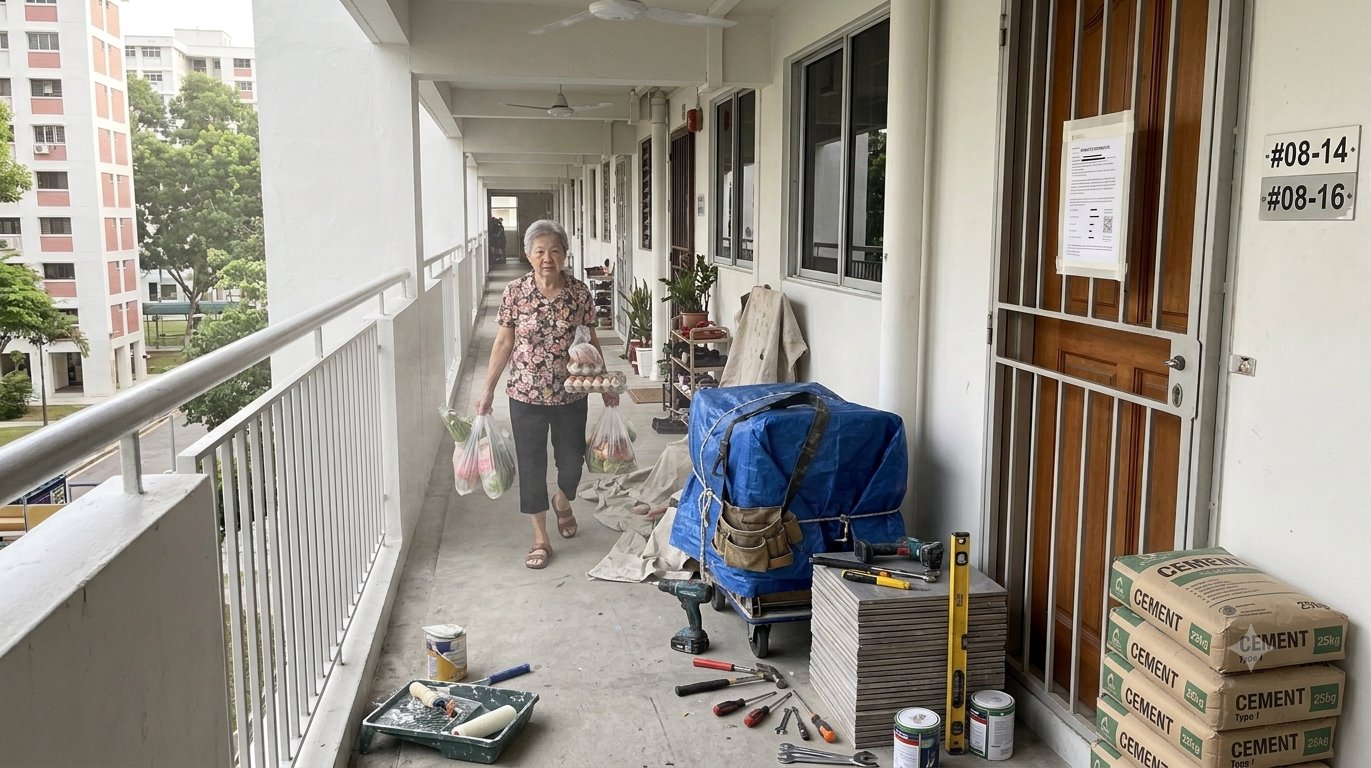
The Neighbour's Noisy Renovation — PSLE oral stimulus picture
Let your child look at the picture for 30 seconds before the first question.

The questions

Ask these in order. Wait five full seconds after each one before helping — the silence is where the thinking happens.

Q1 Describe the stimulus

Look at the picture. What is happening in this HDB corridor?

Look, name, and explain what you see — then add one detail nobody else would notice.

0:00
Model answer

In the picture, renovation work is going on in one of the flats along an HDB corridor. There is a renovation notice pasted on the door, a stack of tiles left outside, and a covered trolley used for carrying materials. A resident is walking past with her groceries, having to move around the items on the floor. What I also noticed is that the corridor is a shared walkway, so the materials are blocking a path everyone on that floor needs to use.

Why it scores

Describes the scene and identifies the real issue — the obstruction of a shared space.

Show the answer frame instead
  1. Point to what you see"In the picture, I can see…" — name two or three specific things, not just one.
  2. Explain what is happening"It looks like… because…" — link what you see to why it is happening.
  3. Add one closer detail"What I also noticed is…" — this is what lifts a plain answer into a strong one.

Q2 Relate it to yourself

Tell me about a time noise or disturbance affected your home.

Give a real example from your own life. Say what happened, then how you felt.

0:00
Model answer

The unit above ours was renovated for about six weeks last year, and the drilling usually started in the morning and went on through the afternoon. It was manageable on school days, but during the holidays it was difficult, especially when I was trying to do revision. My father spoke to the contractor and asked whether the noisiest work could be done in the mornings only, and they agreed. It did not stop the noise, but knowing the afternoons would be quiet made it much easier.

Why it scores

A real disturbance, a reasonable conversation, and a realistic partial solution rather than a perfect one.

Show the answer frame instead
  1. Set the scene"This reminds me of the time when…" — say when and where in one line.
  2. Say what you did"What I did was…" — one clear action, not a list.
  3. Say how it felt or what you learnt"After that, I felt… because…" — examiners are listening for this part.
Q3 Give your opinion

In your opinion, how should neighbours settle disagreements about noise? Why?

Take a clear stand, give a reason, acknowledge the other side, then close.

0:00
Model answer

I feel neighbours should speak to each other directly first, and politely. Most people renovating are not trying to be inconsiderate, and they may not realise that someone works night shifts or has an infant at home, so a friendly conversation often solves it. It also helps to ask for something specific and reasonable, such as avoiding the noisiest work at certain hours, rather than simply complaining. If that does not work, then involving the town council is fair, but I believe going straight to a complaint often damages a relationship that has to continue for years.

Why it scores

Assumes good faith, gives a practical technique, and closes with a point about the ongoing relationship.

Show the answer frame instead
  1. Take a clear stand"I feel that… / I agree that…" — never start with "maybe".
  2. Give your strongest reason"This is because…" — one solid reason beats three weak ones.
  3. Show you see the other side"I understand why some people feel that…, however…" — this shows maturity.
  4. Close it"That is why I believe…" — a proper ending, not a trailing off.

Useful phrases for this topic

Frames your child can use while answering these questions. Tap any phrase to copy it.

  • In the picture, I can see…
  • This shows consideration because…
  • I remember a time when…
  • In my neighbourhood…
  • If more people did this…
  • It costs us very little to…
  • What I also noticed is…
  • This reminds me of the time when…
  • I understand why some people feel that way, however…
  • That is why I believe…

Common mistakes on this kind of question

Missing what is wrong in the pictureLook for the one detail that shows consideration — or the lack of it.
Judging harshlyAssuming people are lazy or rude sounds less mature than considering why they behaved that way.
General advice with no example"People should be more gracious" needs a real moment from your own life to support it.
Answering in one line"Yes, I would." A full answer needs a reason and an example — aim for three or four sentences.
No reason givenEvery opinion needs a "because". Without it, the answer sounds like a guess.

Parent script — how to run this in 10 minutes

  1. Show the picture. Say nothing for 30 seconds.
  2. Ask Q1 exactly as written. Count to five in your head before you help.
  3. After the answer, ask "why?" once more. That single word usually doubles the answer.
  4. Repeat for the remaining questions.
  5. Finish with one thing that was good and one thing to try next time. Only one of each.

More topics like this

All 102 drills are free · No account · No payment

Want one picked for you each week?

Choosing between 102 drills at 8pm on a school night is its own problem. Leave your email and we will send one drill every Monday — nothing else, and you can stop any time.

One email a week. No spam, no sharing of your address.