All topics Environment & Sustainability

🌱 Environment & Sustainability ✍️ Full model answers

Wild Crocodile Encounter

Stimulus-based conversation practice · 3 questions · about 10 minutes

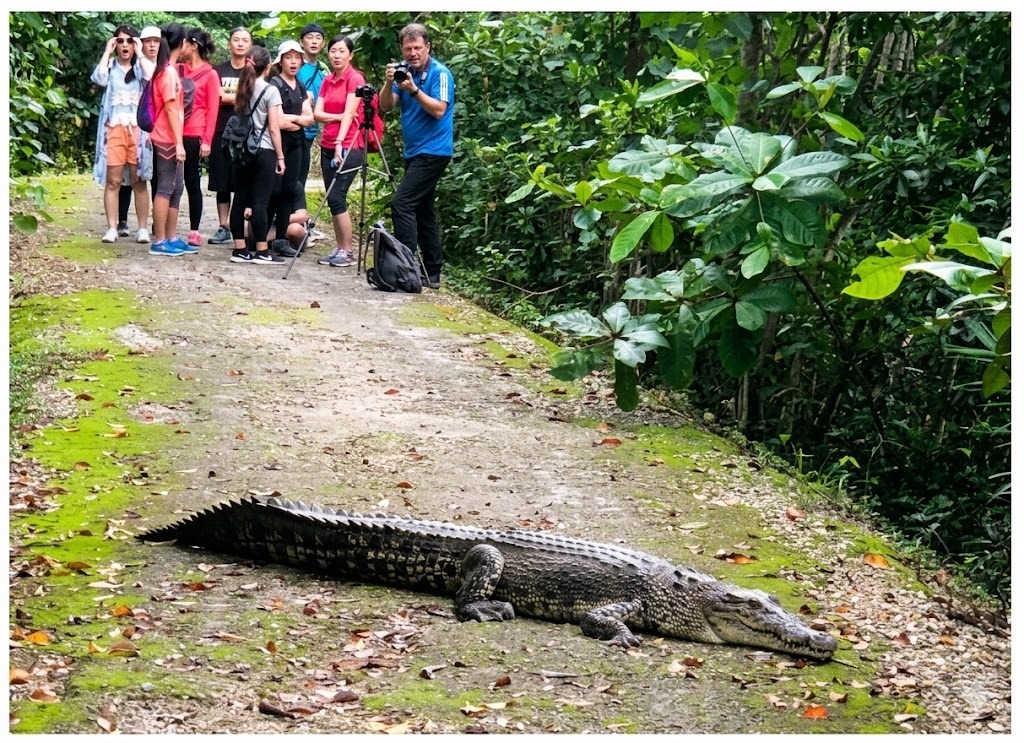
Wild Crocodile Encounter — PSLE oral stimulus picture
Let your child look at the picture for 30 seconds before the first question.

The questions

Ask these in order. Wait five full seconds after each one before helping — the silence is where the thinking happens.

Q1 Describe the stimulus

Look at the picture. What is happening, and do you think the people are safe? Why?

Look, name, and explain what you see — then add one detail nobody else would notice.

0:00
Model answer

In the picture, a wild crocodile has appeared near a public area, possibly at a park or reservoir, and members of the public are nearby watching it. I do not think they are safe, because a crocodile can move very quickly over a short distance and some people appear to be standing quite close in order to take photographs. What I also noticed is that there does not seem to be any barrier or warning sign between them and the water.

Why it scores

Answers both parts, explains the danger with a real fact, then notices what safety measure is missing.

Show the answer frame instead
  1. Point to what you see"In the picture, I can see…" — name two or three specific things, not just one.
  2. Explain what is happening"It looks like… because…" — link what you see to why it is happening.
  3. Add one closer detail"What I also noticed is…" — this is what lifts a plain answer into a strong one.
Q2 Relate it to yourself

Tell me about a time you saw an animal in the wild or somewhere unexpected. How did you react?

Give a real example from your own life. Say what happened, then how you felt.

0:00
Model answer

I once saw a monitor lizard while cycling along the park connector at Sungei Ulu Pandan. It came out of the drain and crossed the path only a few metres ahead of me, and I braked so suddenly that I almost fell off my bicycle. My first reaction was to freeze, and then I waited on the spot until it had gone into the bushes. Afterwards I found it quite exciting, but at that moment my heart was beating very fast.

Why it scores

Honest reaction rather than a brave one, with a clear before-and-after in how it felt.

Show the answer frame instead
  1. Set the scene"This reminds me of the time when…" — say when and where in one line.
  2. Say what you did"What I did was…" — one clear action, not a list.
  3. Say how it felt or what you learnt"After that, I felt… because…" — examiners are listening for this part.
Q3 Give your opinion

In your opinion, what should people do when they meet a wild animal in Singapore? Why?

Take a clear stand, give a reason, acknowledge the other side, then close.

0:00
Model answer

I feel people should keep their distance and stay calm. The most important thing is not to approach the animal for a photograph or try to feed it, because feeding makes wild animals lose their fear of humans and return to the same place. We should move away slowly rather than run or shout, and then inform NParks or the authorities so they can handle it properly. Singapore is quite green and we live close to nature, so learning to share space safely matters more than trying to remove every animal.

Why it scores

Practical steps, explains why feeding is harmful, then closes with a mature perspective on coexistence.

Show the answer frame instead
  1. Take a clear stand"I feel that… / I agree that…" — never start with "maybe".
  2. Give your strongest reason"This is because…" — one solid reason beats three weak ones.
  3. Show you see the other side"I understand why some people feel that…, however…" — this shows maturity.
  4. Close it"That is why I believe…" — a proper ending, not a trailing off.

Useful phrases for this topic

Frames your child can use while answering these questions. Tap any phrase to copy it.

  • In the picture, I can see that…
  • This is wasteful because…
  • A small change we could make is…
  • At home, my family tries to…
  • If everyone did this, then…
  • It may seem small, but…
  • What I also noticed is…
  • This reminds me of the time when…
  • I understand why some people feel that way, however…
  • That is why I believe…

Common mistakes on this kind of question

Describing without judgingThe question usually asks whether something is right or wasteful. Say what you think, not only what you see.
Vague solutions"We should recycle more" says nothing. Name one specific action a family could actually do.
Forgetting the local angleMentioning Singapore's own situation — imported food, limited land, Semakau Landfill — lifts an ordinary answer.
Answering in one line"Yes, I would." A full answer needs a reason and an example — aim for three or four sentences.
No reason givenEvery opinion needs a "because". Without it, the answer sounds like a guess.

Parent script — how to run this in 10 minutes

  1. Show the picture. Say nothing for 30 seconds.
  2. Ask Q1 exactly as written. Count to five in your head before you help.
  3. After the answer, ask "why?" once more. That single word usually doubles the answer.
  4. Repeat for the remaining questions.
  5. Finish with one thing that was good and one thing to try next time. Only one of each.

More topics like this

All 102 drills are free · No account · No payment

Want one picked for you each week?

Choosing between 102 drills at 8pm on a school night is its own problem. Leave your email and we will send one drill every Monday — nothing else, and you can stop any time.

One email a week. No spam, no sharing of your address.